


With more EVs on UK roads than ever, the UK breakdown industry has adapted to meet the specific needs of electric vehicles. Learn about breakdown cover for electric cars, and what’s new for 2026.
If you’ve recently bought your first electric car, or you’re thinking about doing so, you probably have some questions.
- How does EV breakdown assistance work?
- Is it the same as with petrol or diesel cars?
- Do I need specific EV breakdown cover?
Here’s how electric car roadside assistance works, and what you can expect from your provider.
Core process (very similar to petrol cars)
In short, the electric vehicle recovery process is very similar to that of a combustion engine vehicle (diesel, petrol) or a hybrid.
You simply contact your provider by phone or using an app (if provided). A recovery agent/patrol is then sent to your location, where they will try to fix your vehicle and get it back on the road.
If the technicians can’t get you up and running again, they will recover your EV to a garage, your home, or your destination (the exact rules on this may vary with provider or cover level).
So the basic repair/recovery system for EVs is the same as with more traditional powertrains - such as petrol engines.
Note: Most providers offer general breakdown cover for cars, covering both EVs and combustion engine vehicles so you probably wouldn’t need a specific ‘EV breakdown cover’ product.
What’s different for EV repair/recovery?
However, there are some differences between ‘traditional’ and EV roadside assistance.
First of all, technicians will carry out high-voltage safety checks before recovery. If the battery is damaged or overheating, special handling will be required which is why technicians get EV-specific training.
How EVs are actually recovered
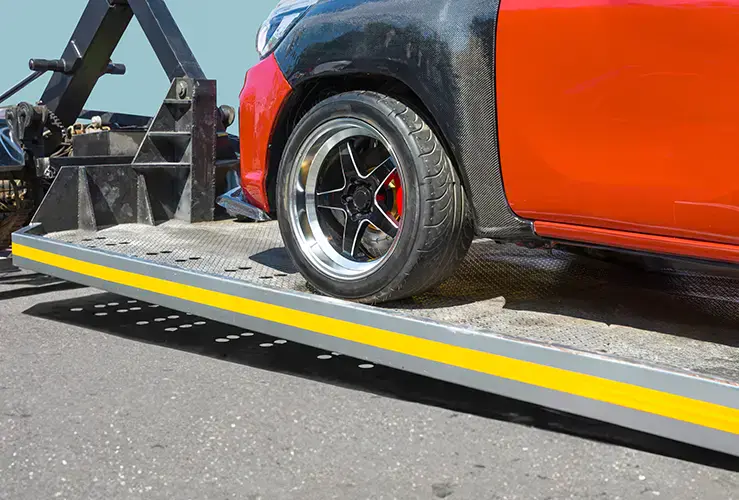
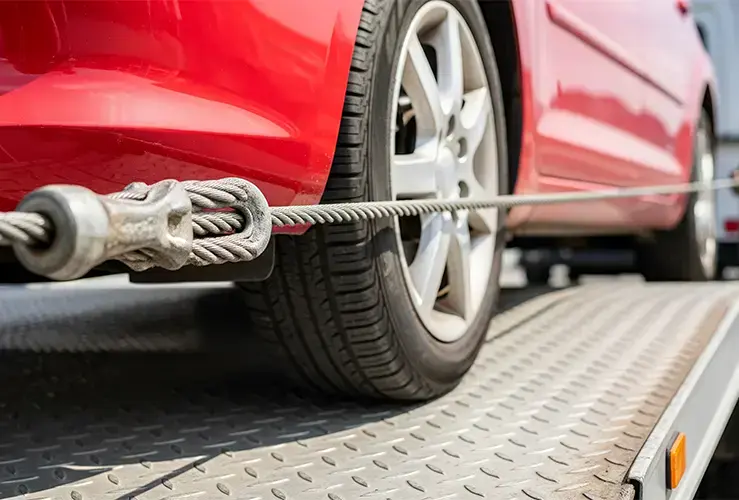
If the technicians can’t fix your EV and get it going again, they will need to organise recovery. In most cases, EVs are winched onto a truck, in the same way as might happen with a combustion engine car.
Recovery teams usually use “all wheel-up” recovery trucks (so no wheels are on the road), in order to avoid damage to the drivetrain.
It is then taken to either a garage, a charging point (if it’s run out of charge) or your home address.
What happens if you run out of charge?
If you run out of charge, you’ll need a top-up. With this in mind, recovery firms operate mobile charging vans that can give your vehicle a quick boost (say, 10 miles of range).
If there’s no mobile charging van nearby, the recovery team may tow (flatbed recovery to avoid damage to motor) your vehicle to the nearest charging point.
Running out of charge is basically treated in the same way as a petrol/diesel car running out of fuel.
Note: Every EV has specific towing instructions; some allow for limited methods (e.g. dollies), others don’t. Failing to adhere to these rules could invalidate your insurance or warranties, so it’s a good idea to familiarise yourself with any such rules.
In most cases, when recovering an EV the wheels should not be moving.
Breakdown cover for electric cars: What’s typically included?
The good news is that EV cover is essentially the same as petrol/diesel recovery. Indeed, many providers - including startrescue.co.uk - offer a general ‘car breakdown’ policy which includes EVs as well as petrol and diesels.
With this in mind, you generally get the following in your breakdown cover policy (these might vary depending on cover level etc.):
- 24/7 roadside assistance
- Recovery to garage or destination
- Help at home
- Onward travel (hire car, hotel, etc.)
Electric vehicle recovery: What’s changed in 2026?
1. EV-specific equipment is now standard
- Mobile charging vans (“EV boosters”) are increasingly common on UK roads
- More recovery trucks designed for EV-safe towing (critical to avoid motor damage)
Before these devices were rare, but now they are expected (and indeed essential as more people switch to electric vehicles).
2. EV technician training has become widespread
- Patrols now get training in high-voltage systems
- EV know-how is no longer a niche skill - it’s industry standard
One of the early barriers to EV widespread adoption was the lack of EV technicians to deal with electric breakdowns, but this has largely changed.
3. Faster, more specialised electric vehicle breakdown recovery methods
- The “All wheels off the ground” recovery method has become industry standard
- This reduces damage risk and waiting time
4. “Out of charge” is fully integrated into cover policies
- Running out of charge is now treated as a normal breakdown scenario
- Included in most policies (not an add-on anymore)
In the early EV days this was sometimes excluded by some providers or was unclear in the terms and conditions.
This means EV owners now have the same peace of mind as petrol/diesel car owners.
5. App-based recovery and location tracking
- Apps provided by breakdown providers (including startrescue.co.uk) can automatically send your GPS location and vehicle details.
- This means dispatch and communications are faster and clearer, making the whole process less stressful.
6. EVs don’t actually break down more often
With the discussion around running out of charge, you might think that this is a common issue. However, only 1-2% of electric car breakdowns relate to this problem.
Indeed, experiencing a flat 12V battery is much more common than running out of charge in the main battery.
Top 4 electric car breakdown causes in the UK
Rank | Issue | What happens | How common | Easy roadside fix? |
1 | 12V battery failure | Car won’t start / “dead” electronics | Very common | Often jump-start or replace |
2 | Tyre problems | Puncture, blowout | Very common | Usually fixable (repair/inflate) |
3 | Electrical / software faults | Errors, system won’t boot | Moderate | Sometimes (reset), often recovery |
4 | Flat main battery (out of charge) | Car stops due to no charge | Rare (~1–2%) | Usually tow or mobile charge |
7. Integration with charging infrastructure
But when an EV does run out of charge, recovery operations usually prioritise the nearest rapid charger, not just the “nearest garage”. This has become standard practice for electric vehicle breakdowns.
Electric vehicle breakdowns in 2026: Key takeaways
Dealing with an EV breakdown in 2026 uses similar processes and infrastructure as combustion engine car breakdowns, just with upgraded tools. Roadside assistance for electric cars is often sold as general ‘breakdown cover’ for all car types.
In short, breakdown recovery has not been reinvented for EVs - it has simply adapted.
The real changes relate to better equipment, better (and more relevant) training, and better handling of battery-related issues.
All of which gives you the same peace of mind as you had with your old petrol or diesel car.