



Microplastics aren’t only found in the world’s oceans: they’re generated by vehicles, and so are present on our roads and in our cabins. Learn about car-related microplastic pollution, how it can affect you and your passengers, and what you can do to minimise it in your day-to-day motoring.
The term ‘microplastics’ is steadily seeping into the public consciousness due to worries over their effect on our health and the environment.
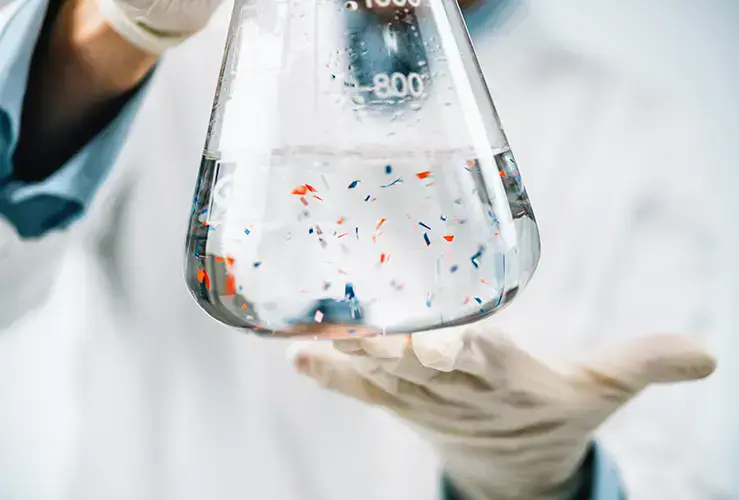
These tiny pieces of plastic (measuring less than 5mm) come off larger pieces of plastic, or have been manufactured in small sizes in the first instance. They have been detected almost everywhere: in our oceans, in the air we breathe, in our rubbish and even in our table salt.
It’s no surprise then, that they are in our cars too.
Microplastics? In my car?
Modern vehicles are manufactured using an array of different materials, including plastics. Over time, microplastics slough off these plastic components through wear, friction and general degradation.
From air filter grilles to doorhandles, mirror housings to seatbacks plastics are found throughout the average car.
But your tyres are the biggest source of microplastic in your car. As you drive over the road surface, tiny particles of rubber and plastic come off, floating into the air and then settling on roads and nearby environments.
Brake pads, too, contain synthetic materials that are released each and every time you depress the brake pedal.
Inside your cabin, dashboards, trims, and synthetic materials all degrade over time, particularly with UV exposure, releasing particles.
What’s more, microplastics from other vehicles accumulate on the roads, and enter your car via airflow. Taken together, millions of cars being driven every day are a major contributor to microplastic pollution, both in the UK and globally.
How they affect your car (directly)
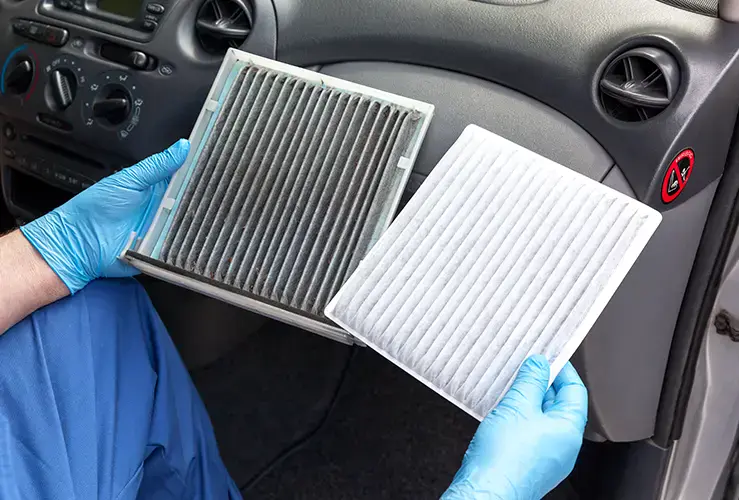
The air quality of your cabin is directly impacted by microplastics, which enter your vehicle via the ventilation systems. While air filters catch some of these particles, they don’t catch them all. Over time, these air filters get clogged up, reducing their ability to filter out microplastics and other unwanted particles.
Particles from interior surfaces, meanwhile, are released from general wear, contributing to the build up of dust.

Microplastics’ effect on humans
When it comes to microplastics’ effect on humans, there are a lot of unknowns. But the scientific community is broadly in agreement that they’re not good.
According to Professor Bernardo Lemos of Harvard T.H. Chan School of Public Health, “There are so many unknowns, but we are seeing more data that suggest microplastics affect human biology.”
There’s particular concern about ‘nanoplastics’, which are particles smaller than 1 micrometre - small enough to pass into human cells.
In a car context, occupants may inhale nanoplastics and microplastics, particularly in high traffic areas.
The long-term health impact is still being researched, but there’s concern about links to respiratory irritation and broader health effects.
As cabin environments are enclosed, airborne particles can become concentrated, therefore intensifying microplastics’ effects on occupants.
EVs vs petrol cars: is there any difference?
It’s possible that electric vehicles may produce more particles from tyre wear, due to their heavier weight together with their instant torque, both of which increase friction (which is why EV tyres tend to wear out quicker than those of petrol or diesel vehicles).
But it’s not all bad news when it comes to EVs and microplastics: regenerative braking actually reduces brake dust, resulting in fewer brake-related particles.
In terms of cabin environment, both EVs and combustion engine vehicles are affected by unwanted particles to a similar degree.
Why are plastics harmful to the environment?
Scientists, health organisations and the general public are increasingly asking: why are plastics bad for the environment?
Sadly, the environmental effects of plastics are numerous. At the core of the issue is the time it takes for them to break down (hundreds of years). Larger pieces of plastic break down into microplastics, which end up in our soil, air and water.
Plastics are also harmful to wildlife, and release toxic chemicals into the environment, which can find their way into the food chain.
They are also very difficult to trap and recycle, as has been widely publicised, and are very bad for our oceans (not least because they can end up in the fish impacting their fertility, and entering the human food chain).
So in short, the environmental effects of plastics are serious and varied - and are very difficult to manage.
What can you do as a driver?
There are a number of steps you can take to reduce the amount of particles in your cabin.
First and foremost, aim to replace your air filters regularly. Consider HEPA (High-Efficiency Particulate Air) filters, if compatible.
You should also try to drive smoothly. Gentle acceleration and braking will reduce tyre and brake wear in the long term.
Keeping your interior clean will also help. Vacuum with HEPA filters to remove settled particles. These work well because they catch the very small particles as well as the larger ones.
You should also make use of recirculation mode in heavy traffic. This limits intake of polluted air from outside.
Finally, choose tyres that are designed for lower levels of wear.
Microplastic facts: at-a-glance
Fact | Explanation |
Defined by size | Microplastics are typically less than 5 millimetres in diameter - that’s smaller than a grain of rice. |
Can be microscopic | Many particles are invisible to the naked eye, measuring down to microns (millionths of a metre). |
Created through breakdown | Larger plastic items degrade over time due to sunlight, friction, and weathering, forming microplastics. |
Found everywhere | They’ve been detected in air, water, soil, and even inside living organisms, including humans. |
Difficult to remove | Their tiny size makes them difficult to filter out using standard cleaning or water treatment systems. |
Microplastic pollution and cars: The big picture
The issue of microplastics doesn’t only relate to our oceans. It is intimately connected to our motoring lives, with particles present on our road networks, and inside our vehicle cabins.
Of primary concern here is tyre wear, which is now recognised as a major source of microplastic pollution globally. Indeed, cars aren’t just emitters of exhaust fumes, they’re mechanical sources of particulate pollution.
But given the increasing awareness of the issue, both regulation and innovation (e.g. tyre design and filtration systems) are beginning to find solutions.
The fact that your vehicle is quietly generating and circulating microplastics every time you drive is not a comfortable truth, but just as modern cars have presented a way of reducing reliance on fossil fuels and cutting motoring costs, the world’s carmaking boffins are seeking ways to tackle microplastics too.
In the meantime, there are steps you can take to minimise their effects on you and your passengers.