


Are electric scooters legal? Can you ride electric scooters on the road? Do you need a licence for an electric scooter? Find the answers to these questions and more, with our comprehensive guide.
E-scooters are nothing if not divisive.
Some of us were early adopters under trial schemes - viewing them as an easy and pleasant way to zip around town, nip to the shops, or visit friends.
Others find the way they suddenly appear out of nowhere, or occasionally occupy pathways that should be the preserve of pedestrians and cyclists as annoying or perhaps even dangerous.
Some motorists are dismayed to find they are sharing public roads with them - especially when contrary to the law.
Then there are those of us who dislike seeing them toppled over, sometimes surrounded by shattered helmets, blocking footpaths and making our townscapes look unsightly.
But how, and more importantly where, can e-scooters be used legally in the UK? Can they be used on public footpaths, pavements, and parks? How fast are they allowed to travel? And what are the penalties for not using e-scooters properly?
In this article we’ll explain just what is - and is not - allowed as regards the driving scooters of the electric variety.
Background: Electric scooters - rules in the UK
The popularity of electric scooters has soared across the UK in recent years, offering a flexible, eco-friendly - and perhaps above all fun - way to travel. However, their rise has been met with significant legal confusion. While private ownership and sales are widespread, the rules governing where you can actually ride them are surprisingly strict.
In fact, despite tens of thousands of searches every month relating to their legality and use, the vast majority of privately owned e-scooters remain illegal to use on public roads, pavements, or cycle lanes. This guide cuts through the complexity to clarify exactly what is and isn't permitted under current UK law.
Can you ride electric scooters on the road? What about pavements?
Using an electric scooter on a public road or pavement is illegal in most parts of the UK. Anyone caught doing this runs the risk of having their scooter seized by the police under the Road Traffic Act 1988 for having no insurance.
Currently, it is not possible to obtain insurance for a private e-scooter.
Do you need a licence for an electric scooter?
Because e-scooters are classed as ‘powered transporters’ by law, a licence is also required to use one on public roads - whether owned or rented through an approved rental scheme.
Indeed, a number of trials are underway in towns and cities across the UK, where it is possible to rent an e-scooter and use it in designated areas. The fee paid to use these e-scooters includes insurance.
What if you cause an accident while riding an e-scooter?
If you have an accident on an e-scooter and cause damage, injury, or death, the incident will be investigated just as it would if you were in control of a motorcycle or motor vehicle.
Sadly, a number of fatalities have occurred in the UK where use of an e-scooter played a significant role.
I privately own an e-scooter: Where can I ride it legally?
You can ride a privately-owned e-scooter on private land - such as a garden - but only if you have permission from the landowner first.
What about approved rental schemes?
A number of e-scooter rental schemes are currently being trialled across the UK. If you have a valid full or provisional UK driving licence, you can rent these scooters. As mentioned, insurance is included in the fee.
To use such a rental scooter, you usually need to sign up via an app, which will verify you have a valid driving licence.
Can I use my own e-scooter on public roads if a rental trial is taking place?
No, you cannot use your privately owned e-scooter on public roads, even if a rental trial is going on in the area. It is illegal to ride a private e-scooter on public roads, cycle lanes, or pavements, and doing so risks fines, penalty points on your driving licence, and your e-scooter being seized.
Electric scooters and speed: What’s the maximum?
The maximum permitted speed of a rental e-scooter in the UK is 15.5 mph.
Do you have to wear a helmet when riding an e-scooter?
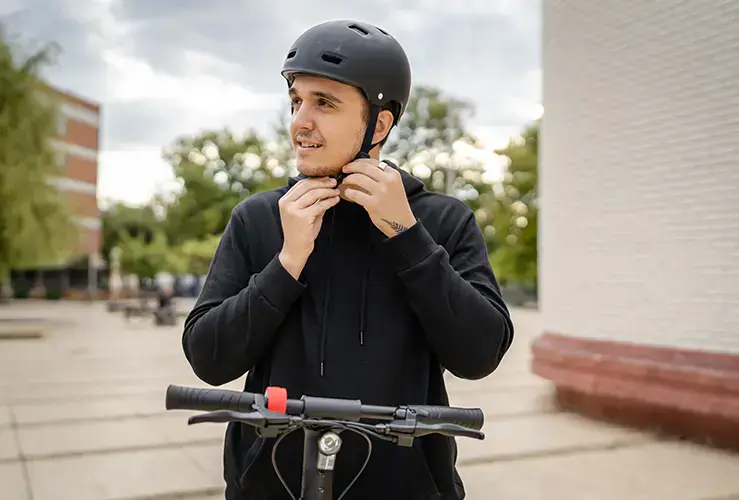
No, you do not have to wear a helmet when riding an e-scooter, but it is strongly recommended. Your helmet should fit well and be securely fastened.
Wearing a helmet can prevent severe head injuries, including traumatic brain injuries, concussions, and skull fractures, which are the most common and severe injuries in scooter accidents. Accidents can happen unexpectedly due to road hazards, other vehicles, or loss of control, and a helmet is the single most important piece of protective gear to protect your brain, which of course cannot be replaced.
Electric scooters: rules for riding
- Where to ride: You can ride on public roads and in cycle lanes, but never on pavements or motorways.
- Speed limit: The maximum speed is 15.5mph (25 km/h), though it may be lower in some areas.
- One rider only: You cannot carry a passenger. Only one person is allowed on the e-scooter at a time.
- Mobile phone use: It is illegal to use a mobile phone or other handheld device while riding an e-scooter. You can set up navigation before you start, but you cannot use a device while moving. If you need to check your route with your phone, you must stop first.
- Safe carrying: Do not hang bags or other items from the handlebars. Securely carry any belongings so they do not endanger yourself or others.
- Intoxication: Do not ride under the influence of alcohol or drugs. This is considered careless or dangerous driving and can lead to prosecution.