


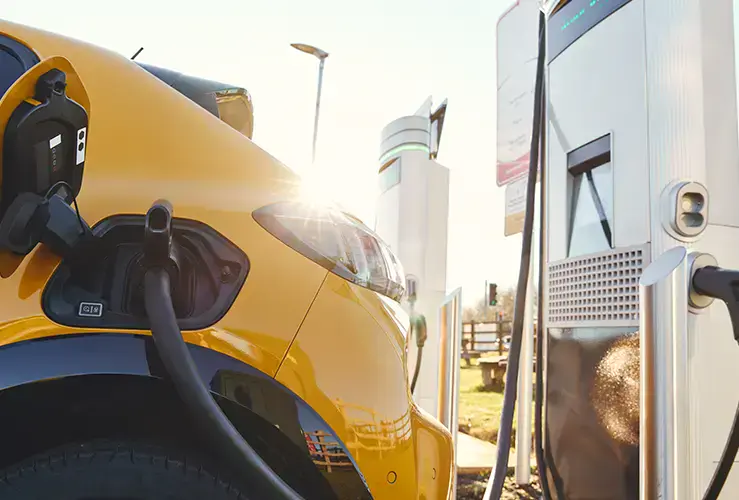
Can’t seem to get a charge from your local EV charger? It’s probably not because the charger is completely faulty. It’s more likely to be due to a communication issue between your vehicle and the charge, a glitch in the app, a payment issue, or a faulty connector.
Here’s what to do when a public EV charger fails on you…
If you drive an electric car, it's very likely that you’ve encountered problems when using public EV chargers.
And it’s not always that the chargepoint is offline - indeed, many charging networks claim an uptime rate of around 99%.
The electric vehicle charging process can go wrong in a frustratingly varied number of ways, including:
- payment or app issues
- connector faults
- vehicle-to-charger communication errors
- damaged cables
- software glitches
How often do chargepoints fail?
When it comes to chargepoints simply being offline or otherwise faulty, recent data is hard to come by. But a 2021 survey by the Competitions and Market Authority (CMA) found that 1 in 25 chargepoints were offline when checked.
That suggests a fail-rate of about 4% - across a network of about 73,000 electric vehicle charging points.
However, the 2024 ZapMap EV Driver Survey reported that 61% of drivers felt that charging had improved over the previous year. While this is positive, the same survey revealed the average satisfaction core for the charging experience was 64/100 - suggesting there is room for improvement.
Ultimately, however, the vast majority of electric car charging attempts are successful.
What should I do if a chargepoint fails?
So, what should you do if your chosen chargepoint - or associated systems - prevent you from topping up your battery and continuing your journey?
First of all, it's likely that a solution can be found quickly.
Here’s what to do:
1. Check the charger status
Look at the charger's screen for any error messages. Open the operator's app (or a service like Zapmap) to see if the charger is marked as out of service, or in use.
2. Reconnect the cable
Next, unplug and reconnect the cable - firmly. If it's a rapid charger with multiple connectors (CCS, CHAdeMO, AC), make sure you've selected the right one for your vehicle.
If you're using your own cable on an AC charger, check both ends are fully inserted.
3. Try starting the session again
You’ll be surprised how often connecting and restarting the session fixes the issue.
End any previous session if possible - then retry using your preferred payment method or the applicable app. If contactless payment doesn't work, see if the operator's app or RFID card works instead.
4. Move to another connector
Still can’t get a charge? Then finding another connector is your best bet. Many electric vehicle charging stations have multiple bays. If one charger won't start, another unit at the same location may work perfectly.
5. Call the operator's helpline
The operator’s helpline isn’t just for registering complaints: the person on the other end may be able to get the chargepoint working again - remotely.
Every public electric car charger should display a support number.
The operator can often:
- remotely reset the charger
- check whether it's experiencing a fault
- help troubleshoot your charging session
6. Find an alternative charger
If you can’t find another working or available connector, it’s time to look for alternative EV charging stations.
Use your sat-nav or an app such as Zapmap to locate nearby chargers - or search for ‘EV chargers near me’ on Google Maps.
If your battery is running low, look for slower chargers at supermarkets, hotels or car parks if they're closer than another rapid charger.
7. Contact your breakdown cover provider if necessary
If your battery is flat - or too low to reach another chargepoint location - then contact your breakdown cover provider. They will be able to take you to the nearest working chargepoint, or your home address if it’s nearby. Some providers also have mobile charging devices to help get you back on the road.
8. Report the fault
Support your local EV community by reporting the issue - as well as helping other drivers it alerts the operator to investigate if they aren't already aware of the problem.
Before you leave home
A little preparation can make charger failures and associated hiccups much less stressful:
- Plan a backup EV charging station (or stations) when embarking on longer journeys.
- Use network apps or search ‘EV chargers near me’ on Google if you need a charge before you begin a trip.
- Keep more than one charging app on your phone.
- Have an RFID card with you (either a physical card or a digital version on your phone).
- Ensure your phone is fully charged to prevent delays.
- Aim to recharge before your EV’s battery drops below around 15–20%. This gives you more flexibility if your first choice is unavailable, and there won’t be a race against the clock to find another chargepoint.