


Driving with passengers who comment on your motoring in real-time can be frustrating, and may even be dangerous if it distracts you. Whether you’re a learner driver, a new driver, or a more experienced motorist, consider these useful tactics for handling “back seat drivers”.
Few of us like being criticised, especially when we’re driving.
But at some point in our driving life, we’re sure to come across that fabled beast:
The Back Seat Driver.
What is one to do with such a car passenger? Turf them out at the motorway services or nearest supermarket carpark?
Such a response might be considered extreme, and may well damage your relationship with that person. It might also be difficult for the person to find onward transport.
The better option is to engage in a little "passenger diplomacy” the implementation of which we’ll discuss in this article.
But first, we’ll look at some of the situations where a driver might first encounter a back seat critic, or carry passengers more generally.
Carrying passengers as a new driver
As a new driver, it can be especially challenging to have passengers in the cabin with you, especially if they offer unsolicited advice or criticism. Learner drivers, on the other hand, should expect guidance from supervising passengers or their instructor.
Indeed, it’s not uncommon for a relative to supervise a learner driver in their early days. This gives real-world experience in carrying passengers, and is perhaps the dictionary definition of “back seat driver” albeit a healthy and constructive back seat driver (hopefully!).
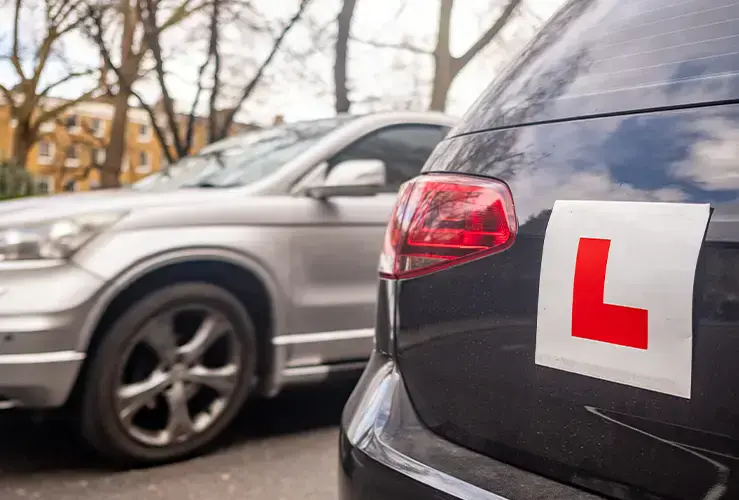
Can a learner driver drive with passengers?
Yes, a learner driver in the UK can have passengers, including friends or family, as long as they have a qualified supervisor in the front seat. Crucially, passengers should not distract the learner. While entirely legal, it's probably wise to avoid passengers initially as they add distractions, but it's good practice for real-world driving but only when the learner/new driver feels ready.
If you’re feeling a little ‘new driver anxiety’, driving with passengers is best left until you’ve got a bit more experience under your belt.
Who can learner drivers drive with?
When practising outside of formal driving lessons, learner driver supervision can only be provided by someone who is:
- At least 21 years old
- Has held a full driving licence for the same type of vehicle (e.g., manual or automatic) for at least 3 years
- Qualified to drive the vehicle type the learner is using (manual vs automatic)
- Not currently banned or disqualified from driving
- Sits in the front passenger seat so they can observe and intervene if needed
Remember that driving with a provisional licence alone is not permitted and can result in some heavy penalties.
Learn more about these rules at Gov.uk
What is passenger diplomacy?
"Passenger diplomacy" in the context of a car journey involves a blend of direct communication, empathy, and pre-emptive strategies designed to handle unwanted/unsolicited driving commentary.
The goal is to maintain safety and calm, while acknowledging the passenger's potential anxiety or concerns.
Immediate in-car tactics
Prioritise safety: Your primary concern as the person in control of the vehicle is that back-seat criticism is distracting, which is a safety hazard.
If a passenger touches controls or their behaviour becomes dangerous, respond immediately and firmly. Indeed, with extreme behaviour you may want to consider whether it’s safe to continue the journey with said passenger (however, this would be a rare scenario).
Acknowledge their anxiety: Often, critics aren't being malicious; they are genuinely stressed out by not being in control. A simple acknowledgement of their feelings can help diffuse the situation. Conversely, ignoring their comments might be counterproductive, and may elicit further and more extreme commentary.
Utilise kind/gentle persuasion: Instead of being confrontational, use diplomatic opening lines. Phrase your request politely, such as, "I hope you don't mind me mentioning it, but I find the comments a bit distracting, and I need to focus on the road".
Agree in a disengaged way: For minor, non-critical comments, you might simply acknowledge them with a brief phrase like, "That's a good idea" or "Okay," without engaging in a full debate.
Pull over safely (if necessary): If the behaviour persists and becomes a significant distraction, find a safe place to pull over and firmly explain that their comments must stop before you continue the journey. This may seem a little dramatic but the person should, by then, understand how distracting, annoying and therefore dangerous their comments are.

Long-term and preventative strategies
Address the behaviour directly (out of the car): In a calmer setting (a motorway service station or supermarket car park would do in a pinch), explain that their comments are distracting and potentially dangerous. You might say something along the lines of, "I appreciate you wanting to help me be a better driver, but I find the comments stressful and would really like for you to not do that while I drive, please".
Offer them the driver's seat: A powerful tactic is to suggest they drive instead, if you feel it's safe to do so. This puts the responsibility on them and often reduces their criticism when they are faced with the task themselves. Aim to ask the question in a sincere, low-volume and non-bitter way, since asking “Would you like to drive?” might sound like a sarcastic rhetorical question.
Utilise technology: Use GPS or mapping applications to bypass arguments about directions or the "best" or “quickest” route. Stating that you're following the app's directions removes personal opinion from the equation: only the terminally foolhardy argue with Google Maps!
Set expectations: Before beginning any journey, especially with a known "back-seat driver" in the cabin, set some clear ground rules.
You might say: "Just so you know, I'll be using GPS for directions, and I would appreciate no comments while I'm driving so I can concentrate". If you can say this in a slightly light-hearted good humoured way, do so unless you feel this might be used as a ‘green light’ for comments.
Reframe the person’s role: For some people, criticism comes from a place of wanting to "coach" you. You might consider asking them to be a designated "coach" and give specific feedback at the end of the journey, rather than delivering real-time critiques. This might help them feel heard and valued without compromising safety.
However, letting someone criticise your driving, even after the event, might feel like appeasement and leave you feeling angry and resentful towards the person. You might only do this if you feel the person has some knowledge and experience that might benefit your driving and if the person genuinely wants to help, rather than simply to be seen as an “expert driver”.

What do psychiatrists say about “back seat drivers”?
While there have been no studies focussed entirely on “back seat drivers”, analysis of the phenomenon has been carried out as part of wider studies (related to psychology or automotive behaviour).
For example, a 2024 New Zealand survey found about 82% of drivers admit to being back-seat drivers, with almost half doing it regularly. About a third stated it affected the driver’s experience.
In the UK, one motorist survey suggested about 70% find back-seat drivers very annoying, especially when passengers react loudly or dramatically to braking, criticise decision-making, or give unsolicited directions again hinting at psychological irritation and distraction.
When criticism is more likely to be ego-driven
Sometimes, a passenger may simply wish to appear knowledgeable, rather than to provide useful feedback. Psychologists find it’s more often about appearing to be “expert” when the critic:
- Was not asked for feedback
- Delivers it publicly (e.g. in front of other passengers)
- Focuses on minor or trivial errors
- Offers no practical solution
When criticism is more likely to be genuine
On the other hand, criticism is more likely to be genuinely helpful when:
- It’s done in private
- It’s specific and actionable
- It’s framed around improvement, not designating fault
- The critic shares responsibility or vulnerability
- The recipient (e.g. the driver) has asked for some feedback