



Dashcams for cars commonly come in two configurations: front-only, and front-and-rear. Learn which is the best dashcam for your needs or whether it’s time to upgrade your front-only system for a two-camera, front-and-rear setup.
According to recent data, over a third of UK motorists (34%) now have a dashcam system installed in their vehicle. That figure is likely to increase, as drivers see the value in being able to provide video evidence if they’re involved in a collision, and being able to send dashcam footage to police in situations where there may have been dangerous driving.
Indeed, the latter often results in offending drivers getting warnings or Fixed Penalty Notices which can give some solace to motorists who witness unsafe driving practices.
But what kind of setup is best a front-only dashcam, or front-and-rear dashcam?
The answer may seem obvious since front-and-rear dashcams capture events to both the front and rear of your vehicle. So the real question is, if you have a front-only setup, is it worth investing in a front-and-rear system?
Front-only dashcam: Pros and cons
A car camera mounted facing the front can capture most accidents/events that occur in front of your vehicle (but not, of course, those that are obscured by your bonnet). They are effective for recording traffic incidents, intersections, and head-on events.
However, by their nature, front-only cameras cannot capture rear-end collisions, or hit-and-run parking incidents.
Front-only dashcams do have some minor benefits though: they are cheaper than front-and-rear systems, and you only have to manage one video stream, rather than two.
Dashcam front-and-rear: Pros and cons
Car cameras mounted front-and-rear are able to capture most incidents that happen in front of you (just as with front-only cameras) but can also record events that happen behind you, like rear-end collisions.
Further, front-and-rear dashcams can give more context to an event. For example, if a driver overtakes you at speed, and pulls in front of you in a dangerous manner, then the rear camera will provide more information on how that driver was behaving before the incident, or if there were any other parties involved.
As well as providing more context in accidents, front-and rear systems provide backup footage if the other driver claims something, and generally better coverage for insurance and police reports.
Downsides to dashcams with front-and rear coverage include a higher installation price and a little added complexity of having to deal with two video streams.
Parking mode: Not only found in the best dashcam systems
‘Parking mode’ was once the preserve of the best dashcams on the market. But these days, ‘parking mode’ is provided with most dashcam systems, even the entry-level ones. In parking mode, the recording system ‘hibernates’ until activity is detected, when it begins capturing footage. It’s especially useful if you don’t have off-street parking, or tend to park in higher risk, public areas. Naturally, this feature provides better coverage if you have a two-camera setup.
Cloud-connected dashcams
While parking mode has become ubiquitous, ‘cloud connected dashcams’ have only been on the market for a few years and as such tend to be found in the more costly, higher-end devices. These work by streaming video data to cloud servers in real time. The main advantage of such a system is that the data is stored remotely, so if your vehicle is broken into and the dashcam stolen, then you’ll still be able to retrieve the footage.
Conversely, with a regular local-storage dashcam, the recordings will vanish along with the hardware.
Cloud-connected features are usually found in front-and-rear dashcams but are sometimes offered with front-only devices.
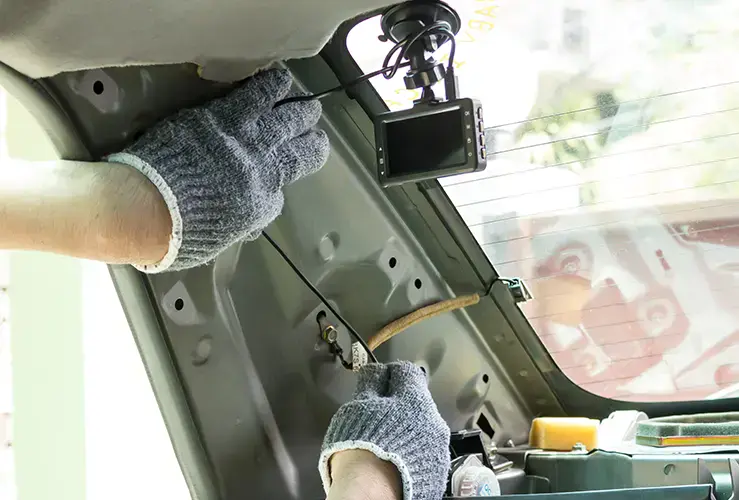
How much is a dashcam with front-only coverage?
Most single-camera, front-only dashcam systems cost under £100.
When purchasing any sort of dashcam, the higher the resolution, the better. For example, a 4K dashcam will be able to pick up much more detail than a 1K system (things like numberplates and road signs). However, even if you have a 4K system, poor lighting, blurring and reflections can still make it difficult to see details like numberplates.
How much is a dashcam with front-and-rear coverage?
It won’t come as a surprise that front and rear camera setups tend to cost more than front-only models. A good quality front-and-rear system with features like cloud connectivity starts at around £200 and can exceed £500.
However, it’s possible to find budget front-and-rear options for under £100. That said, when it comes to dashcams, it might be wise to focus more on quality, reliability, and useful features (like cloud connectivity), rather than price; a cheap dashcam could be a false economy if it develops a fault after a few months, or has poor resolution.
Conclusion: Front vs front-and-rear
Having a front-only camera system is vastly preferable to having none at all. If you have a limited budget, or live in a low risk area installing such a system can make sense.
But having both front and rear dashcam coverage will help you pick up more events. You’ll be able to provide a fuller picture to both police and insurance companies and be able to prove that you weren't ‘at fault’ (assuming you weren't!). If you drive frequently, and/or often park in unfamiliar or higher risk areas, the best dashcam for you is likely to be a two-camera setup.
So if you can stretch to a front-and-rear system, it could prove to be worth the investment.