


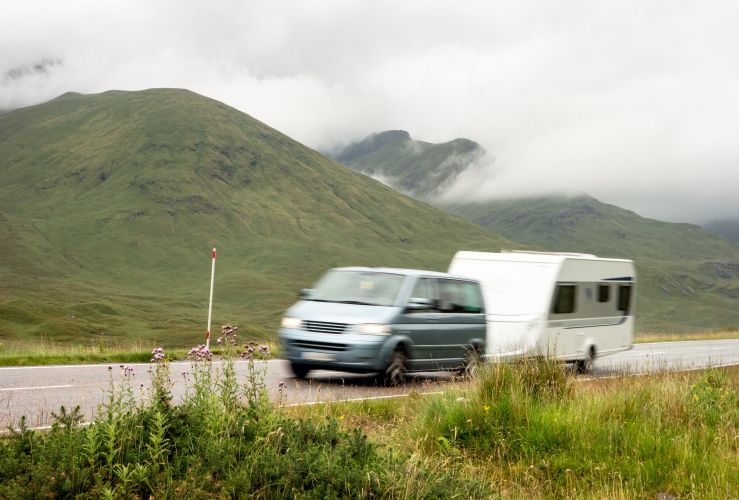
Caravan holidays continue to be one of Britain's favourite ways to explore the countryside and coast. However, successful trips start long before you leave your driveway.
Whether you're an experienced caravanner or preparing for your first trip, following a few simple caravan safety tips can help prevent breakdowns, improve stability on the road and reduce the risk of accidents.
From tyre inspections and loading techniques to legal towing requirements and caravan breakdown cover, this guide explains the key aspects of caravanning safety and towing a caravan safely throughout the summer season.
Essential Caravan Safety Checks Before Every Trip
Before setting off on any journey, it's worth carrying out a few simple inspections to ensure your caravan is roadworthy and safe.
Key checks include:
- Inspect caravan tyres for wear, damage and correct pressure
- Test all lights and indicators
- Check the breakaway cable is correctly attached
- Ensure wheel nuts are secure
- Confirm the caravan is loaded correctly
- Test caravan brakes
- Check mirrors provide adequate rear visibility
- Verify towing connections are secure
- Confirm gas bottles and interior items are safely secured
These simple caravan safety tips can help reduce the likelihood of roadside incidents and improve towing stability.
Drivers should also review the latest towing guidance available from GOV.UK.
Check Your Caravan Tyres Before Travelling
Take some time to scrutinise your tyres and ensure they have the minimum 1.6mm tread depth. But unless your caravan has been used for many years on the same tyres, it is unlikely the tread depth will be worn. According to the Caravan Club, UK caravans have an average mileage of around 2,000 miles per annum.
Old tyres should be replaced; once every five years, according to the British Tyre Manufacturers’ Association. However, you may find your caravan's tyres will last longer than this, particularly if they are only seldom used.
Look out for:
- Grit and debris lodged in the tyre treads
- Perished rubber
Maintain Correct Caravan Tyre Pressure
Ensure tyres are pumped to the PSI recommended by the manufacturer. This figure should be in the handbook, or alternatively available online.
Note that caravans do not possess the elaborate suspension systems found on cars - they must do "more work" and so must be pumped to the optimum pressure
Check your lights and indicators
Check that there’s no damage to your vehicle road lights or indicators, and that they’re all working correctly.
Breakaway Cable
A breakaway cable is designed to engage the brakes of a caravan should it become detached from the tow vehicle.
It is a legal requirement for all caravans with brakes to be fitted with a breakaway cable.
There are two types of breakaway cable clips available:
- The spring clip, which must be attached to itself in a loop and never directly to the tow bar structure.
- The carabiner-style clip, designed for direct attachment to a designated point.
If there is no designated attachment point on the tow bar, the cable can be looped around the tow ball neck.
When fitting the breakaway cable, make sure there is enough slack in the cable so that it doesn’t pull on the brakes when turning.
Each time before towing your caravan, check the breakaway cable to ensure:
- the cable is not frayed, worn or damaged in any way
- there’s enough slack in the cable so that it does not accidentally apply the car brakes
- the cable will not drag on the ground when you’re driving
Avoid Overloading Your Caravan
It is important to ensure that your caravan is properly loaded, so that it doesn’t negatively affect your towing performance.
Furthermore, overloading your caravan can be dangerous so make sure that you are not exceeding the recommended payload for your caravan - the MTPLM (maximum technically permissible loaded mass).
You should also ensure you have suitable caravan breakdown cover in place before travelling, particularly if you're heading long distances or touring mainland Europe. Specialist cover can help provide roadside assistance, recovery and onward travel support if your vehicle or caravan suffers a breakdown.
Caravan maximum load weight
It is recommended that the weight of your loaded caravan does not exceed 85% of your car's kerb weight.
Some car manufacturers advise a MTPLM that is lower than 85% of your car kerbs weight, as being the maximum your car can pull safely. If your car’s recommended maximum towing weight is lower than 85%, you should not exceed this as your upper limit for your loaded caravan’s weight.
To check your caravan does not exceed the recommended maximum weight, use a public weighbridge or a commercial weighing plate.
Find out further details on legal towing weights.
How to Load a Caravan Safely
How you load items into your caravan is also important:
Store heavy items over the axles
When loading your caravan, heavier items should be placed over the axis, with lighter items being placed up and around this.
Weight distributions of your load should be spread evenly across either side of the caravan.
This should make the caravan more stable when braking or taking corners.
It's a very bad idea to store heavy items in overhead lockers and cupboards since they could fall during transit.
If you can, place heavier items in the car, and lighter (and larger) items in the caravan.
Check load is secure
Having first set off, it's a good idea to stop after a short period to check everything in your caravan is secure.
Invest in wing mirror extensions
You should fit suitable towing mirrors if your caravan is wider than the rear of your car.
There is a legal requirement for you to have mirrors that allow you to see clearly an area that is 4 metres wide from the side of your caravan at a distance 20 metres behind the driver.
You can be fined up to £1,000 and get 3 penalty points for towing without proper towing mirrors.
When on the road, bear in mind the following caravanning safety considerations:
Braking distances are longer
Due to the extra mass behind you, it will take longer to stop.
Be aware of this and give yourself plenty of time to stop at junctions etc.
Take a wide line on corners
Taking a wide line on corners will reduce the chances of hitting the kerb.
Reversing into a parking space
To start turning, turn the steering wheel in the opposite way to the way you would normally, then turn the wheel the normal way, so the car can move in the same direction as the caravan.
Too much oversteer could result in a jack-knife. If you oversteer and you think you might not make the manoeuvre, brake, move forward and make another attempt.
Consider investing in a reversing camera to assist you with reversing when hitched up.
Consider fitting stabilisers
Stabilisers help prevent your caravan from "snaking" - and from being generally unstable.
What is “snaking”?
This is when the caravan axles become out of sync with those of the towing car. If it isn't addressed, the caravan can start snaking from side to side, and control can be lost. To prevent this, maintain a straight line. Conversely, using counter-steer to eliminate snaking could make the situation much worse.
If your caravan starts to "snake":
If the caravan begins swaying from side to side:
- Stay calm and maintain a straight steering position.
- Ease off the accelerator gradually.
- Avoid harsh steering inputs.
- Do not brake heavily.
- Allow the vehicle and caravan to slow naturally.
If travelling downhill, reduce speed carefully using gentle braking and engine braking where appropriate.
Caravan Towing Laws and Legal Requirements
Before towing a caravan, it's important to understand the legal requirements that apply in the UK.
Key rules include:
Driving licence requirements
The entitlement required depends on when you passed your driving test and the weight of your vehicle and caravan combination.
Towing mirrors
You must use towing mirrors if your caravan is wider than your tow vehicle.
Failure to use appropriate mirrors can result in:
- A fine of up to £1,000
- Three penalty points on your licence
Weight limits
You must not exceed:
- Your vehicle's maximum towing capacity
- The caravan's MTPLM
- The vehicle's Gross Train Weight (GTW)
Breakaway cable
A breakaway cable is legally required on caravans fitted with brakes and must be correctly attached before every journey.
Always check current regulations before travelling, particularly if towing abroad.
Conclusion
Caravan holidays offer freedom, flexibility and a fantastic way to explore the UK and beyond. By carrying out regular vehicle inspections, following caravan safety tips, understanding legal towing requirements and ensuring you have suitable caravan breakdown cover, you can significantly reduce the risk of problems on the road.
A little preparation goes a long way towards towing a caravan safely and enjoying a stress-free holiday from the moment you set off.