


More than half of vehicle thefts in England and Wales now involve manipulation of remote-locking signals, according to government figures. And with criminals increasingly exploiting electronic vehicle security, someone could potentially gain access to your vehicle by making a copy of your car key - without actually taking possession of the original keys.
Vehicle key systems have become vastly more sophisticated over the last two decades - forcing car thieves to become equally sophisticated.
According to Home Office figures, in the year ending March 2024, 58% of vehicle theft offences in England and Wales involved offenders manipulating the signal from a remote-locking device.
That’s a big increase from 40% in the year ending March 2023 - and just 13% in the year ending March 2019.
Another government estimate suggests that about 60% of vehicle thefts in London involve electronic devices.
Meanwhile, figures for the year ending March 2023 identified two especially common methods of vehicle theft: manipulation of remote-locking signals (40%) and the offender using a key or electronic fob (32%).
These figures highlight how vehicle theft has evolved. Criminals no longer necessarily need to break into a car or physically steal its owner's keys to gain access - practices which were more common 20+ years ago.
But there’s another question: Could somebody actually make a working car key copy without you knowing?
The answer is yes - although the difficulty depends heavily on the type of key involved, as well as the make and model.
Traditional mechanical car keys - as common in older vehicles - are relatively straightforward to duplicate. Anyone with temporary access to the original may be able to have a car key copy made - without the owner necessarily knowing about it.
Copying car keys: What happens when you visit a locksmith?
Can you copy car keys without ID? If a locksmith is asked to make a physical copy of some car keys, they won’t necessarily ask for verification of ownership. Vehicle security professionals are, however, more likely to verify ownership when it comes to transponder key duplication, smart key replacement, programming an additional electronic key, or replacing all keys when none are available.
Modern security systems
Modern vehicles generally use more sophisticated security systems than physical keys.
Transponder keys contain an electronic chip that communicates with the vehicle's immobiliser. Simply copying the metal blade isn’t enough to start the engine; a compatible electronic credential must also be present.
Smart keys and keyless-entry systems introduce another layer of complexity for would-be thieves. These communicate electronically with the vehicle, allowing drivers to unlock doors and start engines - both without physically inserting a key.
Although these systems offer convenience over older security systems, they also introduce potential security vulnerabilities.
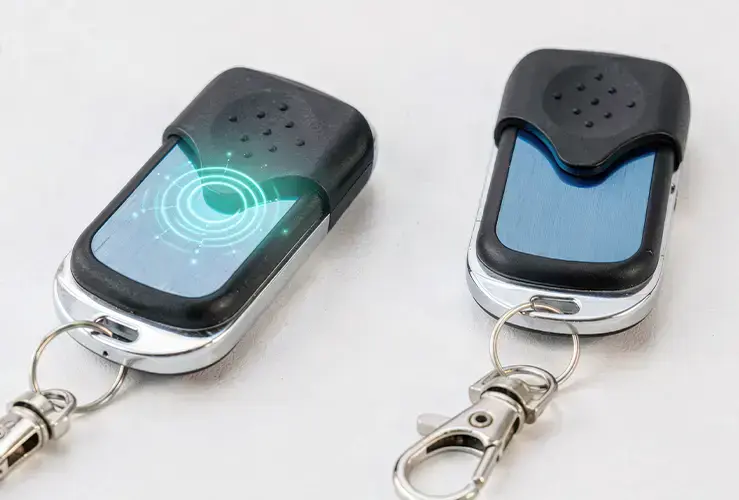
Three ways criminals can gain access to your car
It is important to understand that key duplication, key cloning and relay attacks are not the same.
1. Key duplication and cloning
A conventional duplicate key is a physical copy of an existing key: the traditional process of copying of a car key. With electronic keys, however, the process is more complicated because the vehicle must recognise the electronic credentials as being legitimate.
Depending on the vehicle, specialised equipment and access to the appropriate programming procedures may be needed.
If a working electronic duplicate is created successfully, it can potentially operate independently of the original key.
This is an important point for motorists to understand: taking back your original key does not automatically invalidate a duplicate.
2. Unauthorised key programming
Many of today’s vehicles allow additional keys to be registered with their electronic security systems.
This is a standard, legitimate function - used when owners buy replacement keys, or need extra ones. But if someone manages to register an unauthorised key, they may effectively gain their own independent means of accessing and starting the vehicle.
Unlike a relay attack, which is often only a one-off breach, this can create an ongoing security problem.
Depending on the vehicle, the unauthorised key may continue working until it is removed from the vehicle's authorised-key list or the security system is reconfigured.
3. Relay attacks
Relay theft has hit the headlines a lot in recent years, particularly in connection with keyless-entry vehicles. A case in point is the spate of relay attacks on Range Rovers in London from 2019 to 2022, where 7,376 thefts were recorded by the Metropolitan Police across those three years.
Instead of physically copying a car key, criminals exploit the communication between a car and its bona fide smart key.
The vehicle is effectively tricked into believing that the authorised key is nearby, potentially allowing the doors to unlock - and the engine to start.
But a relay attack does not necessarily create a permanent duplicate of the key.
If thieves drive away with the vehicle, they may be able to continue driving while the engine is running - but once the engine is switched off, they may be unable to restart it without another valid key credential.
It’s important to note that how a system behaves varies between manufacturers and models.
So relay theft exploits an existing key's electronic signal, while cloning or unauthorised key programming can - potentially - give criminals a separate, lasting way of getting into and running the vehicle in question.
Car key duplication and unauthorised entry methods
Method | Requires physical access to original key? | General difficulty | Can provide repeated access? |
Mechanical key duplication | Usually yes | Easy | Yes |
Transponder key duplication | Usually yes, or access to vehicle/key programming | Moderate | Yes |
Smart-key duplication | Not necessarily, depending on the method | Moderate–High | Yes |
Unauthorized key programming | Usually requires vehicle access or specialized equipment | Difficult | Yes |
Keyless-entry relay attack | No physical possession of the key, but proximity to it is generally needed | Moderate–High | Potentially, while conditions permit |
Stolen or borrowed original key | Yes | Easy | Yes |
Unauthorized access through an existing digital key | Access to an authorized account/device or shared credential | Variable | Yes, until revoked |
Physical lock manipulation | No | Variable | Not necessarily; may only provide temporary entry |
How widespread is electronic car theft in the UK?
Electronic vehicle theft is a significant worry for UK motorists.
Government figures provide some insight into the changing nature of vehicle crime - which arguably demands a good degree of security system know-how compared to decades ago.
According to figures provided in a parliamentary answer in November 2025, manipulation of remote-locking signals was involved in around 58% of vehicle thefts in England and Wales in the year ending March 2024.
This compares with 40% in the year ending March 2023 and 13% in the year ending March 2019.
It’s clear that electronic methods of illegally accessing vehicles have become much more common.
However, it is important not to mix up signal manipulation with key duplication. What the figures don’t tell us is how many vehicles were stolen using cloned keys or unauthorised additional keys.
There is currently no reliable national UK statistic establishing how many car keys are secretly duplicated each year.
Nevertheless, the figures do tell us that vehicle security should be taken seriously.
How would you know if someone had copied your car key?
Unfortunately, there may be no obvious warning signs that something is amiss - except of course in a case where your vehicle has been taken.
Why might someone want to access a vehicle - without necessarily stealing it?
It might seem illogical to want to access a vehicle without actually stealing it, but there are a number of possible reasons for such behaviour:
- Planning a future theft
- Repeated access to the vehicle (theft of valuables, documents etc.)
- Unauthorised access by someone known to the owner (ex-partner, former employee etc.)
A duplicated key can operate normally without affecting the original. The owner might continue using their vehicle for months without realising that another working key exists.
There are, however, some things to watch out for:
- Unexpected unlocking or locking of the vehicle.
- Evidence that someone has accessed the vehicle without permission.
- Unfamiliar keys appearing in the vehicle's registered-key records.
- Unexpected changes to vehicle security settings.
- Suspicious access to digital-key accounts or shared vehicle credentials.
None of these necessarily proves that a key has been copied, but they warrant further investigation.
How can you protect yourself?
Fortunately, there are several practical steps motorists can take.
Have your registered keys checked. An authorised dealership or suitably qualified automotive locksmith may be able to check how many keys are registered to your vehicle. If you suspect unauthorised access, ask whether unfamiliar keys can be identified - and removed.
Consider reprogramming the security system. If you believe someone has obtained an unauthorised duplicate, simply changing the physical key may not be enough. Depending on the vehicle make and model, the electronic immobiliser and key-registration system may need to be reset.
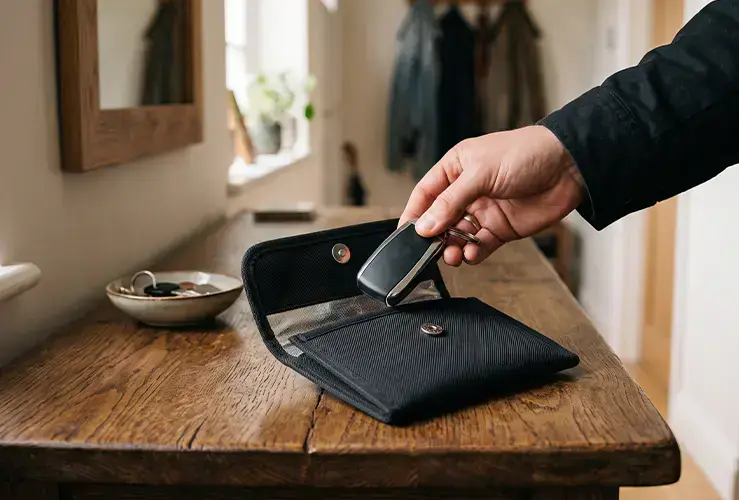
Protect your smart key. Faraday pouches can help prevent unauthorised communication with certain keyless-entry systems. It’s also a good idea to keep your keys away from doors and windows - where practical.
Secure your digital credentials. If your vehicle supports smartphone-based keys, protect your account with a strong password and any recommended authentication measures.
Use additional physical security. A steering-wheel lock or other visible security device can provide an additional deterrent, even on vehicles with sophisticated electronic security.
The bottom line
The days when stealing a car necessarily meant breaking a window, forcing the ignition or physically taking the owner's keys are long gone.
Modern vehicle technology has made driving a lot more convenient, but it has also created new opportunities for criminals.
Someone may be able to exploit a vehicle's electronic security without ever taking possession of the owner's original key. And, in the case of successful key duplication or unauthorised programming, the resulting access may continue on an ongoing basis until the vehicle's security system is updated.
The most important thing to understand is that keeping your original car key safe does not necessarily mean that nobody else has a working copy.
If you have any reason to suspect that an unauthorised key exists, having your vehicle's registered-key list checked is the first step.