



While today’s advanced driver assistance systems such as adaptive cruise control, lane keeping assist, and lane departure warnings - do help us to avoid collisions, there’s growing concern that some drivers may be over-relying, or even getting distracted by, such features - reminding us that two opposing ideas can be true at the same time.
Per mile travelled, UK roads are much safer than a few decades ago.
That’s despite a huge increase in vehicle numbers and congestion levels.
In the early 1970s, there were around 14 million vehicles on UK roads. Today, there are more than 40 million vehicles on the road network. Similarly, miles travelled in 1970 were between a third and half of 2026 levels.
Despite more traffic, road injuries and fatalities have fallen considerably since the 70s, due to things like mandatory seatbelt wearing, airbags, crumple zones, and more strictly enforced drink-driving laws.
The introduction of advanced driver assistance systems
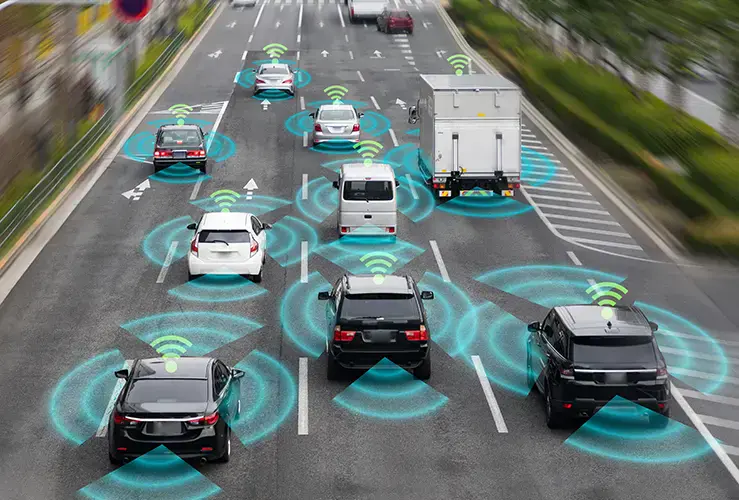
More recently, autonomous car safety systems have further enhanced on-the-road safety, providing drivers with warnings when hazards appear, and even taking control temporarily in order to avoid collisions (autonomous emergency braking being a case in point).
Key advanced driver assistance systems include:
- Lane departure warning systems
- Blind spot monitoring
- Automatic emergency braking
- Adaptive cruise control
However, there’s growing evidence that, in some ways, driver assistance systems might be making some of us poorer drivers.
Encouraging complacency?
Secondary tasks, such as checking phones and looking at advertising outside, present a significant risk to us as drivers and by extension to our passengers and other road users.
Studies suggest that around 16.8% of UK drivers are engaged in these secondary tasks at any given moment when behind the wheel.
Common secondary task/distractions include:
- talking to passengers (8%),
- smoking/vaping (9%),
- hands-free phone conversations (7%),
- handheld phone use (0%).
Among motoring researchers, there’s growing concern that driver assistance systems may encourage a degree of complacency; the notion that we have more room for error because our car’s safety systems will warn us of an imminent danger (or even take over momentarily, in the case of emergency braking).
How safety features may be changing our driving behaviour
Worryingly, there’s some evidence that some motorists may be altering how they drive in order to pre-empt or avoid safety warnings - for example by jiggling the steering wheel periodically (in the case of driver-monitoring or lane-keeping systems).
Some drivers even disable car safety features
In one Australian AAMI study, one in five respondents said they had actually turned off automotive driver assistance systems. 69% of those said they did this because such features are annoying, distracting or are perceived as too sensitive. In the same study, 23% said they didn't feel they needed driver safety features, and 13% said they didn't trust the safety features in the first place.
Lane departure and lane keeping sometimes get turned off
The driver assist systems most likely to get switched off were overwhelmingly lane departure warnings and lane keeping assist. Because some drivers turn these systems off before or during driving, they actually contribute to those dreaded secondary “inattentive” tasks.
Understanding the limitations of driver assist systems
One UK government study on drivers’ understanding of ADAS (Advanced Driver Assistance Systems), revealed a level of uncertainty as regards how much control they have over Level 2 ADAS systems, concluding that “Drivers frequently overestimated the system's ability to handle adverse conditions and complex driving scenarios, which could lead to overreliance and unsafe driving behaviours.”
This problem is often termed “automaton complacency", where humans are generally poor at being able to monitor systems that rarely fail. And it’s not just drivers who are prone to such fallibilities - airline pilots, nuclear plant operators, and industrial workers all face similar issues.
The human brain has evolved to be engaged in active tasks, not passive monitoring. The use of automotive driver assistance systems can mean the brain gradually disengages from active participation in the driving process, handing over micro-decisions to the vehicle itself. The upshot is that reaction times can lengthen, situational awareness can weaken, and attention can drift.

But car safety features do keep us safer on the road
However, there’s no denying that modern car safety features do reduce the risk of collisions. A case in point is a study by the AAMI, which found that Advanced Driver Assistance Systems (ADAS), especially autonomous braking, result in fewer collisions than vehicles that don’t have such features.
Similarly, lane departure warnings and lane keeping assist features are believed to reduce collisions by somewhere between 3 and 18%.
With these findings in mind, it's perhaps important to remember that such features are only designed to assist drivers; genuine autonomous driving, after all, is still some way off.
Focusing on the basics of motoring
Many of us will have younger family members who are learning to drive or are thinking about doing so in the near future. It’s important to remind such individuals of the importance of fundamental motoring especially keeping an eye on blind spots and maintaining a safe distance from the vehicle ahead (and not relying on safety warnings or autonomous emergency braking).
For those of us who have been driving for some years, it might be prudent to think about a driver refresher course, which can iron out any bad habits developed after years on the road.
Most drivers agree that today’s car safety systems enhance on-the-road safety. We simply have to learn how to take advantage of these systems without having them distract us or take unnecessary risks.
Modern car safety features should perhaps be treated as a last line of defence against unexpected hazards, rather than systems that should be overly relied upon.