



For more than 15 years, we’ve been told that “self driving cars” are coming. But what autonomous features have actually made it into our vehicles, and our everyday lives?
You may have seen the recent viral clip of three robo-taxis having a “stand off” in a street in San Francisco where the vehicles appeared to be frozen in motion, blocking traffic.
The incident served as a reminder of the limitations of autonomous vehicles; in certain unexpected situations, self-driving systems (in their current form) cannot function properly.
Waymo, the firm behind the robotaxis in question, described the stand off as a "teachable moment”.
While regular motorists, both in the US, UK and elsewhere, cannot access robotaxi-level technology as consumers, the incident raises questions about the coming ‘self-driving car revolution’.
So, just how autonomous are the features available to today’s driver?
In this article we’ll look at some of the most common autonomous features, and aim to answer the question: just how “autonomous” are they?
How autonomous are today’s self-driving vehicles?
In short, no private citizen, i.e. regular motorist, can get behind the wheel of a fully self-driving car. While some car manufacturers may give the impression their models have some degree of autonomy, in reality these features are ‘driver assist’ functions, which harness autonomous tech in a very limited way, usually to make motoring a little easier and safer.
What is a self-driving car?
While the answer to “what is a self driving car?” may seem obvious, it’s important to understand that there are different ‘levels’ of automotive autonomy. The car industry uses a scale from Level 0 to Level 5:
- Level 0–1: This covers basic assistance (lane warnings, adaptive cruise control).
- Level 2: At this level, the car can steer, accelerate, and brake on its own at the same time, but the driver must stay fully alert and be ready to take over at any moment. This is where all consumer systems sit today.
- Level 3: The car can drive itself in limited conditions without constant supervision, but the driver must still take over when asked to, or when otherwise necessary.
- Level 4: This means the car is truly autonomous in certain areas or conditions (e.g., restricted zones). The Waymo robotaxis mentioned earlier are generally considered to be at this level.
- Level 5: Such a vehicle has full autonomy everywhere, and no steering wheel is required. Decades ago, such systems would have been regarded as ‘science fiction’ but in 2025, they are closer to being a reality than ever.
But for now, no vehicle sold to consumers is above Level 2, regardless of the brand.
Self driving car advantages
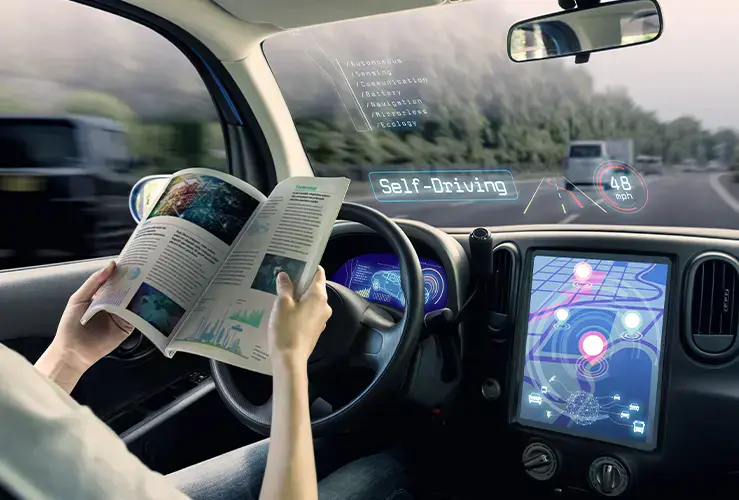
While not everyone is a big fan of the idea of being driven around by hardware and software, there are some big plus points to self-driving cars, including improved safety (fewer crashes), better traffic flow, optimised energy/fuel usage, improved mobility for those who cannot drive, improved productivity (because people will be able work, read etc. while on the move), and importantly the elimination of parking stress!
Artificial intelligence & self driving cars
‘Artificial intelligence’ and ‘self-driving cars’ have been used in the same breath since the dawn of AVs.
While ‘artificial intelligence’ has entered general parlance over the last three years, self-driving cars in fact used advanced AI long before generative AI became mainstream. As early as the 2010s, autonomous-vehicle systems relied on deep learning for perception, sensor fusion to interpret multiple inputs, as well as real-time planning to navigate complex road layouts. This made the automotive sector one of the first, and most demanding, testing grounds for artificial intelligence.
Unlike today’s text and image generators, AI in self-driving cars must operate continuously, react within milliseconds, and make safety-critical decisions in the physical world. It has to interpret unpredictable human behaviour, adapt to weather and lighting, and maintain near-perfect reliability - challenges far beyond producing text or images.
What current “self-driving” systems actually do
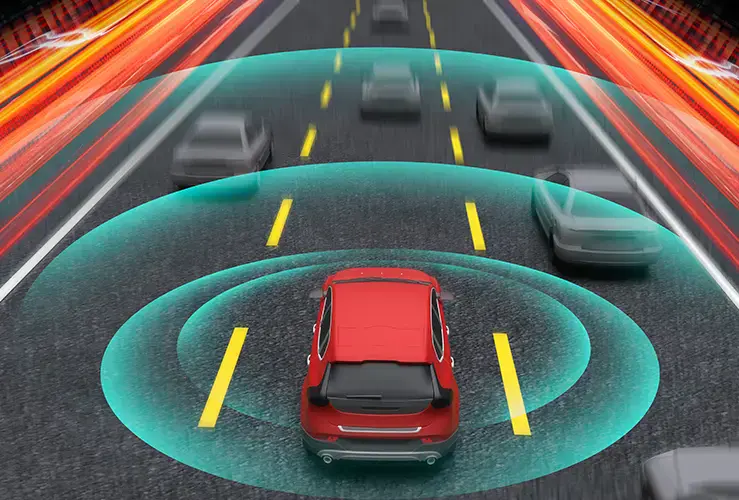
Companies may use impressive-sounding names like Autopilot, Full Self-Driving, Super Cruise, and Drive Assist, but they all fall under (rather lowly) Level 2 Advanced Driver Assistance Systems (ADAS).
Such systems can do things like:
- Keep the car centred in its lane
- Maintain speed and following distance
- Change lanes automatically (in some cases)
- Navigate motorway junctions in limited conditions
- Read some signs or detect obstacles
- Park the car in certain situations
- Perform emergency braking
But they cannot:
- Handle all traffic situations
- Operate without human supervision
- Reliably detect all hazards (construction zones, unusual objects, complex junctions, roundabouts, emergency vehicles, etc.)
- Make judgment calls like a human driver
Sometimes, the marketing used by car makers can make Level 2 seem autonomous. But the fine print requires the driver to stay alert, with their hands on or near the wheel and ready to intervene in an instant.
Why aren’t cars fully autonomous yet?
Various challenges currently prevent vehicles from going beyond Level 2 and towards full-blown self-driving cars.
1. Borderline/edge cases
Human driving involves uncommon, unpredictable situations such as: fallen cargo, erratic drivers, strange road layouts, etc - all things that AI still struggles with.
2. Sensor limitations
Cameras, radar, and lidar still miss things in bad weather, poor light, or glare.
3. Regulation and liability
Car manufacturers are careful not to call their systems “autonomous” because they'd become legally responsible for crashes.
4. The complexity of the real world
Self-driving cars tend to work very well in controlled conditions, but roads populated with human drivers are rather chaotic.
AI & humans sharing our roads: The risky “crossover” period
Assuming all vehicles are driverless in the future, the ‘crossover’ period is likely to be chaotic and dangerous as unpredictable human drivers share the roads with autonomous systems.
Which car brands are developing autonomous technologies?
A handful of car marques are making serious headway on the autonomous vehicle (AV) front. One of the leaders is Mercedes Benz, which has developed a piece of level 3 tech called “DRIVEPILOT”. This allows the driver to take their eyes off the road (legally) in certain scenarios. It has been certified for speeds of up to 95 km/h on German motorways (Autobahns).
BMW, too, is making big AV advances, particularly with its “Personal Pilot L3” plus “Highway Assistant (L2)” combining Level 2 and 3 technology.
Across the pond, GM and Ford have also been working on autonomous systems.
But the real market leader is Waymo - a division of Google. This company has been developing autonomous vehicles since 2009, and has benefited from the deep pockets of its parent company. Indeed, developing autonomous cars is a very costly affair, so arguably only a very large firm could manage it. Waymo is one of the few dedicated self driving car companies in existence.
What about autonomous driving systems from Tesla?
When it comes to autonomous driving, Tesla is arguably some way behind the leading pack of car manufacturers. Tesla has two key systems: Autopilot/FSD (which registered about one crash per ~6.69 million miles driven while the system was engaged), and FSD/Supervised, which helps with city driving, lane changing, and parking. While these systems are impressive in their own right, when it comes to a fully autonomous car, Tesla is some way off the pace.
When will “robo-taxis” come to the UK?
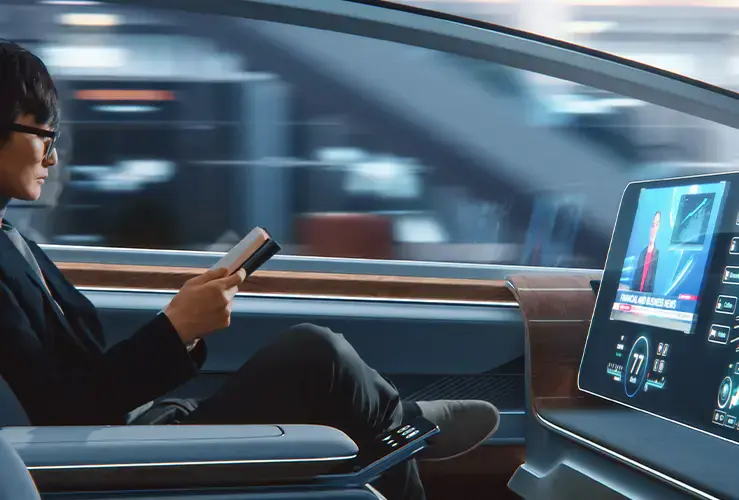
While it will be some years before you are able to get into your very own autonomous vehicle, self-driving taxis could be a reality much sooner.
So-called “robo-taxis” are set to begin trials in Spring 2026 - specifically in London. The main companies involved are Uber (partnering with Wayve) and of course, Waymo. While the final goal is to deliver fully autonomous services, there is likely to be a period of trials, where test vehicles have human drivers as a safety precaution until the government finalises regulations under the Automated Vehicles Act.
What about insurance for self-driving cars?
A number of companies offer, or plan to offer, insurance for self-driving cars, including Tesla, Rivian, and GM. In the UK, a key provider is Zego, which underwrites autonomous vehicle insurance for AV fleets and for technology trials.
However, the question of how to organise insurance for self driving cars is far from answered. It’s likely that as the technology develops, the liability will shift towards AV manufacturers and software engineering firms, since the human driver will “take a back seat” metaphorically and, quite possibly, literally.
Conclusion: How autonomous are self-driving features?
A number of car manufacturers (particularly in the United States and Germany) have developed some impressive Level 2 and 3 self-driving features, but substantial hurdles prevent fully autonomous vehicles from becoming a reality.
Current self driving systems can certainly make driving easier and safer, by doing things like keeping us in lane on the motorway, or dealing with tricky parking spots. But the days when we simply get in our own private cars and ask to be driven to our destination are some way off.
However, robo-taxis give us a tangible and tantalising glimpse into what the future could hold (even if they do get stuck now and again).