


Is it time to upgrade your work van to a Zero Emissions Vehicle (ZEV)? In this article we explore the pros and cons, the increased choice of models, and government grants to help manage the initial outlay.
Is it time for your business to switch from diesel or petrol vans to electric?
It’s a conundrum faced by many small, medium and large enterprises across the UK, not least because the sale of new combustion-engine vans will be banned from 2030. This is part of the UK’s commitment to ‘net-zero’ and tackling climate change.
The promise of lower running costs
Aside from being much better for the environment, lower outgoings in the long term are the main lure of electric vans meaning you could avoid the higher costs of petrol or diesel.
Home charging (overnight charging) is especially low-cost, but this applies to smaller one-person operations/sole traders.
Public rapid charging is more costly than home charging, but is still generally cheaper than the cost of diesel, on a mile-for-mile basis.
Going electric also means lower maintenance and repair costs: because EVs have fewer moving parts, less can go wrong.
Total cost of ownership
According to an analysis by West Motors, the total cost of ownership for a ZEV over five years is around £3,000 lower than a petrol vehicle, factoring in depreciation, electricity/fuel, maintenance, road tax, and insurance.
Range anxiety matters - for some
Often, whether or not going electric depends on what you’ll use the van for.
Businesses that cover large distances in a single day are still wary of the limited range of some electric models, despite increases in range over recent years.
Conversely, firms that operate within a limited radius of their base find that electric vans are more than suitable for their day-to-day operations, and are particularly useful for last-mile distribution.
Payload considerations
ZEV batteries are heavy and take up a considerable amount of space. This can mean they are unable to carry as much cargo as their combustion-engine counterparts (and still be within their GVW limits). Such considerations will matter more to some businesses than to others.
Medium EV vans (e.g., Vauxhall Vivaro Electric, Peugeot e-Expert) often have payloads 150–250 kg lower than their diesel equivalents.
Sales of new internal combustion engine vans will be banned from 2030
One of the biggest reasons to ‘go electric’ is the impending ban on the sale of combustion engine vans in 2030. While you will of course be allowed to use combustion engine vans after this date, it may become more difficult to obtain fuel moving forwards.
Do electric vans pay congestion charges?
Another advantage is that all pure electric cars are exempt from the London Congestion Charge, as well as the Ultra Low Emission Zone (ULEZ) charge.
More electric vans are on the market than ever
The number of electric vans on the UK market continues to expand.
By the end of 2021, there were more than 20 models of fully electric vans on sale. Skip forward to 2025, and there are nearly 40 models to choose from, with scores of variants.
However, electric vans only comprise 8-9% of new van registrations, which is some way short of the government’s target of 16%. Additionally, sales of vans have fallen off recently - but that is unlikely to halt the broad industry push for zero-emission vans.
Corporate take-up only for EV vans?
Electric van take-up has been particularly strong among corporate buyers, who are able to negotiate good deals on bulk purchase, and generally set up hubs and economies of scale that make investing in electric vans worth it. They also have corporate responsibility goals in mind - ensuring they are viewed as ‘green’ by their customer bases.
However, among smaller firms adoption has been slower. That said, in areas affected by congestion charges/low emission zone costs, investing in zero-emission vans has made more sense. Conversely, operating more polluting diesels, for instance, means being penalised for operating in such areas.
For smaller enterprises who may be keen to control costs, investing in used electric vans can make more economic sense.
The price pain-point of electric vans
Cost remains a major hurdle for expanding the zero-emission van market. According to RoadToZero.co.uk, the median price of a ZEV is £53,885, around 7% higher than combustion engine (ICE) vans (£50,540). However, when comparing models on a like-for-like-basis, the price disparity is much bigger, with ZEVs costing 47% more than their ICE equivalents.
Again, for some operations, opting for used models is proving to be a more economically prudent way of going electric.
According to Fleet News, the average price for a used electric van in the UK is approximately £17,560, a significant decrease from the previous average of £24,435 in June 2023.
What about government grants for electric vans?
The UK government does provide a grant towards the cost of a new electric van, as part of the Plug-In Van and Truck Grant (PIVG) scheme. It’s built-in to the forecourt price; you don’t need to apply for it yourself. The model must be included on one of these Low-emission vehicles eligible for a plug-in grant..
Earlier incarnations of the plug-in van grant stipulated a maximum RRP, but the current PIVG scheme has no RRP limit.
However, the Plug-in Wheelchair Accessible Vehicle (WAV) has an RRP limit of £50,000.
Government EV grants for small vans
For small vans (GVW < 2.5 tonnes), the grant will pay for 35% of the purchase price, up to a maximum of £2,500.
Government EV grants for large vans
For large vans (GVW 2.5–4.25 tonnes), the grant will pay for 35% of the purchase price, up to a maximum of £5,000.
Eligibility criteria:
- Vehicle type: Must be categorised as a light van (N1) or truck (N2/N3) under EU definitions UK.
- Zero-emission range: Minimum of 96 km (60 miles) electric-only driving Parkers.
- CO₂ emissions: Less than 50 g/km UK.
- Warranty: Light vehicles require at least 3 years or 60,000 miles (whichever comes first) coverage, including battery/fuel cell performance UK.
Plug-In Van and Truck Grant (PIVG) summary
Van Type | GVW Range | Grant Rate | Maximum Grant | RRP Cap? |
Small Vans | < 2.5 tonnes | 35% | £2,500 | None |
Large Vans | 2.5–4.25 tonnes | 35% | £5,000 | None |
Small Trucks (N2) | 4.25–12 tonnes | 20% | £16,000 | None |
Large Trucks (N3) | > 12 tonnes | 20% | £25,000 | None |
WAV (wheelchair vans) | N/A | N/A | N/A | RRP ≤ £50,000 |
Which size electric van should you consider?
Manufacturers often use the terms ‘small’, ‘medium’ and ‘large’ vans to describe their van products. But in terms of the government’s PIVG scheme, there are only two types of van to think about:
- < 2.5 tonnes GVW - ‘small’ vans
- 5–4.25 tonnes - ‘large’ vans
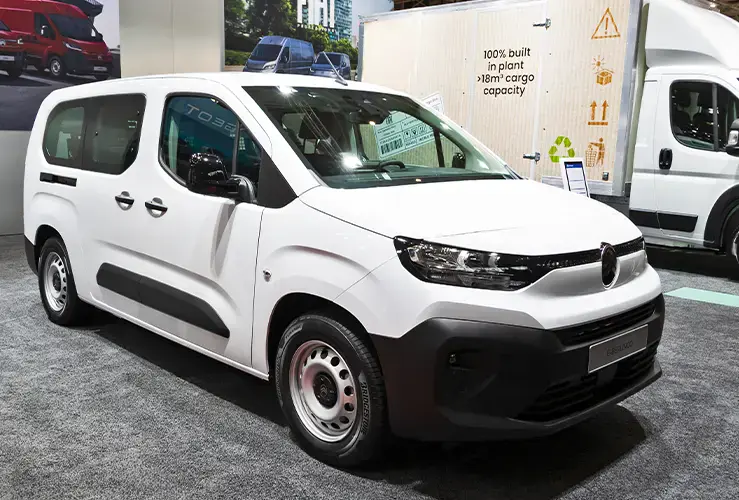
Small electric van
If you’re in the market for a smaller electric van, you have far more choice in 2025 than you did in 2020.
Popular small van models include the Citroën e-Berlingo, Dacia Spring Cargo, Fiat e-Doblo, Ford e-Transit Courier, and Maxus eDeliver 3 (short wheel base variants).
As choice has expanded, so too has range - often a major stumbling block to widespread adoption of EVs in all classes. According to data from Leasing.com, on average, electric van range has risen from 144 miles in 2020 to 198 miles in 2025 - an increase of 38%.
This improvement is due an overall increase in battery capacity.
Medium-sized electric vans
As mentioned, a ‘medium sized electric van’ is really just a marketing term used by manufacturers and dealerships.
Key characteristics of Medium EV vans:
- GVW: typically 2.5–3.5 tonnes.
- Cargo volume: around 5–6.6 m³ (enough for 2–3 Euro pallets).
- Payload: ~900–1,200kg.
- Range: now commonly 150–200+ miles WLTP with bigger batteries.
The following models might be termed ‘medium sized’ in marketing communications, but are still within the ‘small’ category as far as the PIVG scheme goes:
Vauxhall Vivaro Electric
One of the best-selling medium EV vans; up to ~205 miles WLTP range.
Peugeot e-Expert
Shares platform with Vivaro; typically 143–205 miles depending on battery.
Citroën ë-Dispatch
Same Stellantis family; 50kWh or 75kWh batteries, up to ~196 miles range.
Toyota Proace Electric
Toyota-badged version of the Stellantis trio.
Ford E-Transit Custom (2024 onwards)
New entry, filling the mid-size role between the small E-Transit Courier and large E-Transit.
Large electric vans
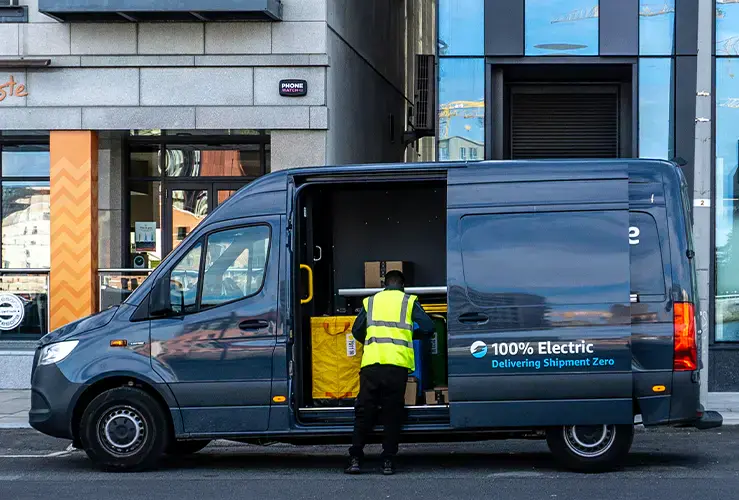
If you expect to carry larger items - or higher volumes of items - then it makes sense to consider a van with more carriage space (and maximum load).
The government classifies vans with a GVW of between 2,500kg and 4,250kg as ‘large vans’ (for the purposes of the PIVG grant). Grant-eligible large vans must also emit “CO2 emissions of less than 50g/km”, and be “able to travel at least 96km (60 miles) without any emissions”.
Grant-eligible ‘large vans’ include the BD Auto eTraffic, BD e-Boxer, DFSK EC31, DFSK EC35, Fiat e-Ducato, Ford E-Transit (Leader), Iveco eDaily and Maxus eDeliver 3, 5, 7 and 9.
These larger vans do come at a cost, which is why mostly larger delivery firms have invested in them.
For smaller businesses or sole traders, it might be challenging to justify the price - unless business is booming.
The same vans with different badges?
Due to the cost of developing electric vehicles, manufacturers have teamed up to spread the risk.
The result is products like the Renault Kangoo, Nissan Townstar and Mercedes-Benz eCitan - all of which are built around the same platform.
Because of this similarity, these brands have been forced to differentiate themselves with things like extended warranties, attractive finance deals and in-life services.
In short, competition does seem to be driving excellence.
While this approach may appear to offer less choice overall, the savings made by manufacturers in development costs mean they can sell the final product at a lower price.
Looking for an electric van with character?
The Morris J-Type van is set to have a revival, with the release of a new electric version of the vehicle set for launch in 2026.
With the J type having been out of manufacture for over 50 years, the new electric J type van is sure to raise an air of nostalgia amongst many! The original J type van was a popular choice of transportation amongst many businesses in post war Britain, including Royal Mail, Cadbury, John Lewis, OXO and Wall’s.
With a range of approximately 200 miles and a payload of 1 tonne, it will cost around £60,000 to purchase the electric J type van when it goes on sale.
How far can an electric van go?
For would-be e-van buyers, range anxiety is a big issue. However, manufacturers are tackling it head-on, with the Renault Master E-Tech boasting an impressive WLTP.
Here’s a list of range-leading electric vans. Do note that real-word driving conditions mean these upper limits are seldom reached.
Also note that a van with a larger battery (and thus more range) may have reduced range as a consequence.
Model | Range (WLTP) | Battery Capacity | Notes |
Renault Master E-Tech | 285 miles | 87 kWh | Largest battery in its class; ideal for long-distance deliveries. (vansdirect.co.uk) |
Mercedes-Benz eSprinter | 275 miles | 113 kWh | Offers flexible configurations; suitable for urban and regional use. (EV Marketplace MOTORWATT) |
Ford E-Transit | 249 miles | 68 kWh | Combines practicality with decent range; popular among UK fleets. (Auto Express) |
Volkswagen ID. Buzz Cargo | 276 miles | 77 kWh | Retro design with modern features; great for city and suburban routes. (Auto Express) |
Fiat E-Ducato | 263 miles | 79 kWh | Versatile van with commendable range; suitable for various applications. (Auto Express) |
How long does it take to charge an electric van?
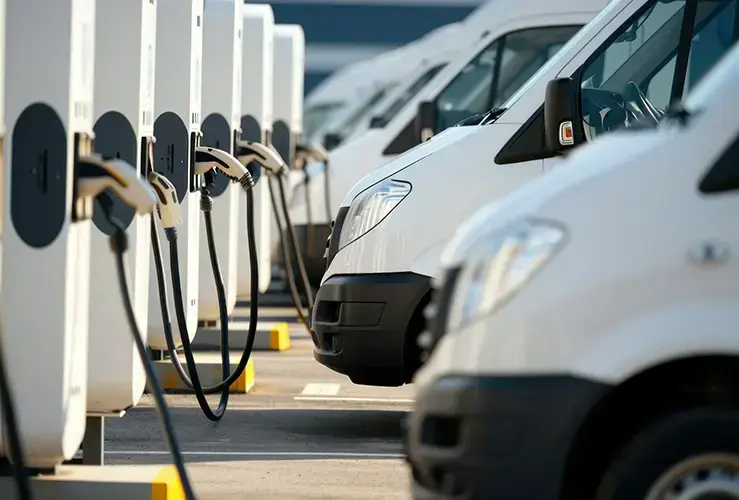
Charging speed, too, has improved a great deal over the past years.
However, how long it takes to charge a van will depend on battery size, charger type, and current state of charge.
Using Rapid / DC Charging (50–150 kW+), you can expect an 80% charge in 30-90 minutes. Fast AC Charging (11–22 kW), meanwhile, can take between 2 and 6 hours. The slowest method is Home / Slow AC Charging (3–7 kW), which can take up to 12 hours.
One of the fastest-charging electric vans is the VW ID. Buzz Cargo, which can achieve an 80% charge in around 35 minutes.
Note: Batteries should generally only be charged to around 80%. Regularly exceeding this will degrade the battery.
Charging infrastructure issues?
Back in 2020, the UK’s charging infrastructure was severely lacking, making the purchase of an electric van particularly unpalatable. As of mid-2025, however, the total has exceeded 82,000 public chargers across more than 40,000 locations.
So, is it time to buy an electric van?
There are many more electric vans to choose from in 2025 than there were five years ago.
This choice, combined with better range and quick charging, has made buying an electric van more attractive than ever.
But as with so many things, it may come down to cost. The initial outlay for many electric vans is significant, and it would take time for those cost savings to add up.
For those with the available funds, now could be a great time to invest in an electric van. For others, it might make sense to wait for prices to come down, or to invest in a used ZEV.
For some, it might make sense to keep running their combustion-engine vans - at least until the 2030 deadline arrives!
What about electric cars?
Not in the market for an electric van but considering buying an electric car?
If you’re wondering, is an electric car right for me? Why not read our article Is it time to buy an electric car?