
For more than 20 years, a raft of urban vehicle charging zones have been established in London and other UK cities, with a view to cutting air pollution and congestion, and improving the health of residents. In this guide we explain what these often-confusing acronyms and abbreviations actually mean, as well as how to do a CC, CAZ, LEZ, or ULEZ check for your own vehicle.
Can’t tell your ULEZ charge from your Congestion Charge?
Not sure if Birmingham has a CAZ or a LEZ?
In an effort to make our roads less polluting and less congested, authorities have dreamt up a smorgasbord of acronyms and abbreviations - an alphabet soup for zones that, one way or another, one day, are probably going to cost you money…
…or possibly already have.
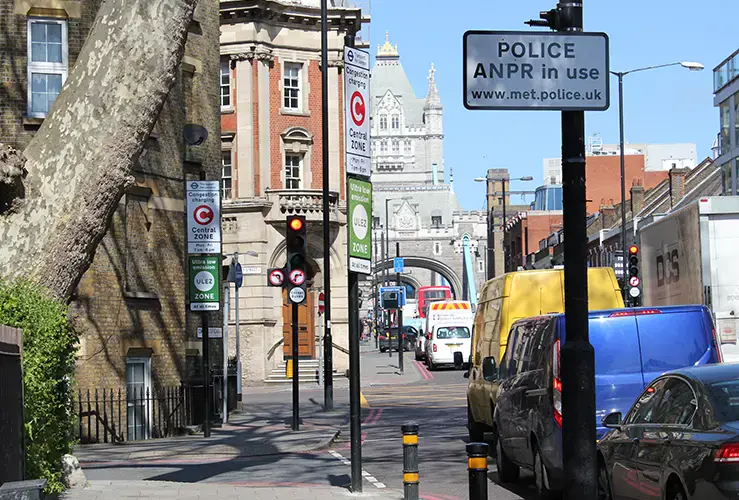
Let’s start with London
Congestion Charge (2003)
London’s traffic management schemes are particularly discombobulating.
As the country’s capital and most populous city (by far), London has had to be the first mover against overly busy roads and high levels of air pollution.
First came the Congestion Charge (2003) which, as the name suggests, was designed to reduce congestion in Central London. This did, and still does, target pretty much every vehicle type.
The scheme generated about £202.8 million in payments between April 2024 and March 2025. But this figure is likely to rise significantly across 2026, as the charge has been increased from £15 to £18 (from January 2026).
Well over two decades have passed since Ken Livingston (the then-London Mayor) introduced the Congestion Charge, so it’s easy to forget just how controversial it was.
The Congestion Charge was labelled as a “stealth tax”, “an attack on drivers”, and as “anti-business”.
In many ways, the London Congestion Charge was just as contentious as ULEZ is today.
You can do a vehicle check to see if you need to pay the Congestion Charge here.
LEZ - Low Emission Zone (2008)
Over a decade before ULEZ, there was the LEZ - Low Emission Zone. This was the first real Clean Air Zone a UK city had ever seen. It came into force in 2008 and targeted heavy diesel vehicle pollution (HGVs, buses, and large vans).
The LEZ barely impacted privately owned cars, but it was still controversial.
Haulage and bus firms had to spend large sums to upgrade their vehicles to Euro IV/Euro V standards, thereby becoming exempt from paying the LEZ charge.
But local authorities outside the LEZ area were less than enthused by the scheme, chiefly because they feared highly polluting vehicles would be pushed in outer London roads, and thus simply displacing the pollution problem from central London to inner and suburban areas.
Yet however controversial LEZ was, it was difficult to rail against the scheme’s stated goal: to reduce respiratory disease, asthma attacks, and long-term mortality.
You can do a vehicle check to see if you need to pay the LEZ Charge here.
ULEZ: Ultra Low Emission Zone (2019 onwards)
Next came the “pièce de résistance” of London’s pollution control measures: ULEZ.
The Ultra Low Emission Zone was first introduced in Central London in 2019, before being rolled out across Inner London in 2021. These two ULEZ zones (which really became just one ULEZ zone) covered around 38 square miles (100 square kilometres) of the capital.
However, this was nothing compared to the final stage of ULEZ, which would encompass Greater London, and around 617 square miles (1,600 square kilometres) forcing many thousands of drivers to pay the ULEZ charge if they wished to continue using their cars.
ULEZ covers cars, vans, motorbikes, and heavy vehicles.
Which vehicles are ULEZ-exempt?
Electric vehicles, plug-in hybrids (certain standards), historic vehicles (40+ years old), and some emergency service vehicles usually do not pay the ULEZ charge.
Has ULEZ been successful?
Yes, in terms of achieving its stated goals, ULEZ has been successful. Older, high-polluting vehicles have been removed from roads, while air quality has improved (nitrogen dioxide (NO₂) and particulate matter (PM10/PM2.5) dropped in monitored locations.
ULEZ has also prompted a big behavioural change as more drivers have switched to compliant vehicles or public transport.
ULEZ checker
Need to do a ULEZ check? You can do a vehicle check to see if you need to pay the ULEZ Charge here.
You can pay ULEZ charges on this page.
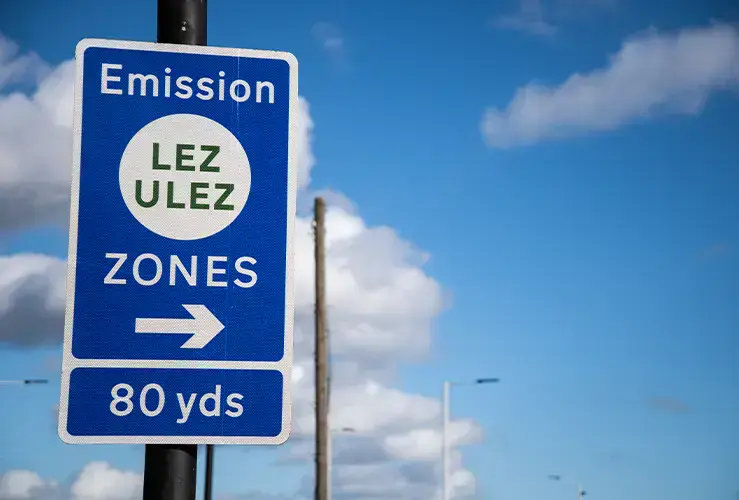
What about the rest of the UK?
CAZ: Clean Air Zones
In 2017, the UK government introduced CAZ (Clean Air Zone) guidance for cities that exceeded NO₂ limits. This was partly inspired by the success of ULEZ.
Clean Air Zones were eventually established in Birmingham, Bath, Bristol, and Portsmouth.
City | CAZ Type | Notes |
Birmingham | Class D CAZ | Charges diesel cars, vans, buses, HGVs; explicitly designed to mirror ULEZ-style restrictions |
Bath | Class C CAZ | Charges only buses, coaches, HGVs, taxis; cars are exempt |
Bristol | Class D CAZ | Includes cars, vans, HGVs |
Portsmouth | Class B/C CAZ | Tailored for specific high-pollution roads |
Cities whose air exceeded NO₂ limits faced legal obligations from the UK government and the EU (before Brexit) to improve the quality of their air.
ULEZ success showed that vehicle charges do indeed reduce harmful emissions, and that the public health benefits outweighed the projected disruption.
However, in order to reflect local political and economic sensitivities, CAZ schemes are smaller and more flexible than ULEZ.
While the measurable successes of CAZ schemes are noticeable, they are not on the scale of ULEZ, which covers a huge area and millions of people.
Gov reg check: How do I check my vehicle emission standards?
Not sure if your vehicle is exempt from any of the UK’s emissions schemes? You can do a gov reg check on the DVLA website. Here you can check ULEZ compliance, confirm fuel type and Euro emissions standard, verify tax and MOT status, and avoid daily penalty charges.
CC, LEZ, ULEZ & CAZ: At-a-glance
Scheme | Where | Purpose | Who Pays? | When | Emissions-Based? | Notes |
Congestion Charge (CC) | Central London | Reduce traffic congestion | Almost all vehicles entering zone | Mon–Fri daytime | ❌ No | £18/day; traffic management, not primarily environmental |
ULEZ (Ultra Low Emission Zone) | All Greater London | Reduce air pollution (NOx & PM) | Non-compliant cars, vans, motorbikes, HGVs | 24/7 | ✅ Yes | £12.50/day (cars); emissions standard based |
LEZ (Low Emission Zone) | All Greater London | Reduce heavy diesel pollution | Mainly HGVs, buses, large vans | 24/7 | ✅ Yes | Introduced 2008; heavy vehicles only |
CAZ (Clean Air Zone) | Selected UK cities (e.g. Birmingham, Bristol, Bath) | Reduce NO₂ pollution | Varies by city (some include cars, some don’t) | Usually 24/7 | ✅ Yes | Government framework outside London |