



In new cars, halogen bulbs have largely been replaced with LED headlights. These are brighter, smarter - and theoretically - safer than the outgoing headlight technology. But why are some LEDs so costly to replace?
20+ years ago, discovering you had a blown headlight bulb was rarely a big deal.
With a new £10-£20 halogen bulb and a few minutes’ work, your headlamp would be up and running again. Even if you needed more advanced Xenon headlights, the replacement cost would be reasonable, and the task straightforward.
Fast-forward to 2026, and if you’re still using old halogen bulbs - or Xenons - you're probably driving either a classic car, or a budget/entry-level model. That's because many modern vehicles have far more complex LED headlights.
With a lot of models, it's not a simple case of headlight bulb replacement - you have to replace the entire headlight assembly - which is likely to cost a lot more than a humble halogen bulb.
How are car headlights getting ‘smarter’?
Today’s car headlights are indeed a lot smarter in 2026, emitting more light and - in theory - helping to keep you safer as you drive.
- LEDs have replaced traditional halogen bulbs on a lot of models (but not all). They use less energy, last longer, and allow designers to create smaller, brighter lighting systems.
- Adaptive headlights can “see” the road ahead. Cameras and sensors can detect traffic, curves, and road conditions, then automatically adjust the beam.
- Matrix/Pixel LEDs can control individual light segments - automating dipped headlights. The system can dim specific parts of the beam to (hopefully) avoid dazzling oncoming drivers - while keeping other areas brightly lit.
- Headlights are becoming part of the car’s electronics network. They can communicate with cameras, body-control modules, steering systems, and driver-assistance features.
So have glare-related injuries fallen with LED headlamps?
The introduction of Matrix/Pixel LEDs theoretically eliminates one of the major issues with halogen bulbs - that they can dazzle other drivers and potentially increase the chances of a collision. Such injuries fell from 369 in 2013 to 216 in 2023. However, the government never actually recorded if halogen or LED lights were involved in these collisions.
Additionally, regarding collision data collection, in 2024 “vision affected by dazzling headlights” was removed and replaced by a much broader category.
Brighter headlights, bigger problems?
And there’s some evidence drivers feel that modern headlights are too bright compared to older car bulbs. One 2026 survey relieved that almost all responding drivers felt at least some headlights were now too bright.
So ironically, while LEDs make it easier to see the road ahead, these brighter headlights may reduce visibility for oncoming drivers.
LED lights on a car: Why are they so expensive to replace?
Today’s LED headlight assemblies can contain many components (lens, LEDs, sensors, cameras, housing etc.). As such, they are complex and time consuming to manufacture - and so cost more.
Then there are labour costs
LED replacement headlights also take longer to swap out - we’re talking up to an hour for a simple assembly, and up to four hours for a complex Matrix LED system. And to change some LEDs, the bumper has to be removed (taking extra time and effort). With mechanics and technicians charging between £55 and £150 per hour, labour can really push up the cost.
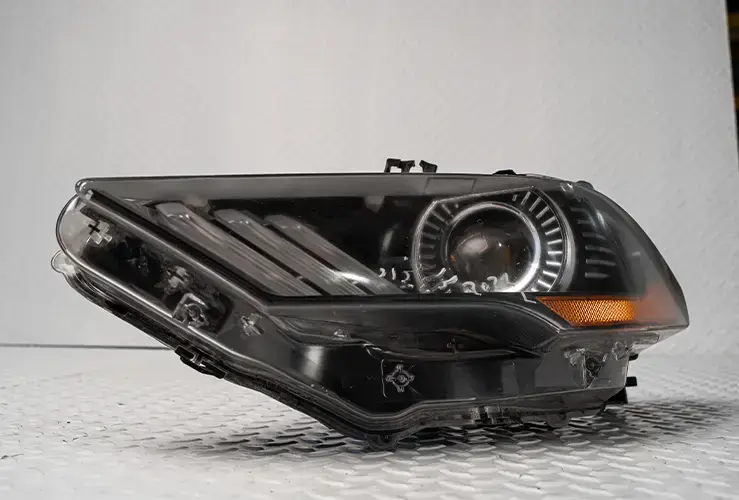
Headlight replacement cost comparison: Budget models to high-end cars
Here are five popular cars in the UK, and how much it costs to replace their headlights.
Car | Headlight technology | Typical replacement part | Labour* | Rough fitted cost |
Toyota Aygo X Icon | 🔸 Halogen | ~£220 | £60–£100 | ~£280–£320 |
Ford Fiesta | 🔸 Halogen / basic LED depending on version | ~£270–£685 | £75–£120 | ~£350–£805 |
VW Golf | 💡 Full LED | ~£675–£800 | £100–£150 | ~£775–£950 |
Audi A3 | 💡 Matrix LED | ~£990–£1,200 | £120–£200 | ~£1,110–£1,400 |
BMW X5 | 💡 Adaptive/Matrix LED | ~£1,400–£1,900+ | £150–£300+ | ~£1,550–£2,200+ |
Common reasons for LED headlight failure
Given how costly LED headlights are to replace, it’s worth understanding what can make them go wrong. If you notice your headlights are dim or flickering, it’s important to get them checked over by a professional as soon as possible. Doing so may help you avoid a more costly repair bill later on.
Issue | How common? | What happens? |
Driver/electronics failure | ⭐⭐⭐⭐ | Headlight stops working, flickers, or shows a fault |
Heat/overheating | ⭐⭐⭐ | LEDs become dimmer or electronics eventually fail |
Water/moisture ingress | ⭐⭐⭐ | Condensation, corrosion, electrical failure |
LED module failure | ⭐⭐ | Part or all of the light stops working |
Wiring/connectors | ⭐⭐ | Intermittent or complete loss of the light |
Cooling fan failure | ⭐ | Overheating or protective shutdown (where a fan is fitted) |
Software/calibration fault | ⭐ | Adaptive functions stop working or produce warnings |
LED “burnout” | ⭐ | The LED itself fails completely |
LED headlights: A bright future?
There’s no denying that LED headlights are much more advanced than halogen or old Xenon headlights. Indeed, Matrix/Adaptive LED variants can dynamically illuminate the road ahead while - theoretically - not dazzling other road users. LEDs also use less energy than older bulb systems.
However, some LED assemblies are costly and complex to replace - which is something to bear in mind and research if you’re thinking about buying a new car, and want to keep long-term maintenance costs to a minimum.