


Car over-revving? Higher-than-usual revs usually means your vehicle has an issue. However, not all problems are as serious as others. Learn how to diagnose engine-over-revving worries before they get out of hand, with our guide.
Noticing that your car is revving higher than usual, even when you’re not pressing the accelerator, can be a worry. It might indicate something minor, like a straightforward vacuum leak, or something more serious with the mechanics or electrics. By understanding the various root causes, you’ll be able to act before the issue becomes more serious, and costly, to repair.
I think my car is over revving: What’s a normal idle?
Most of today’s petrol engines idle between 600–1,000 RPM when the vehicle in question is warm and in neutral, or park. Diesel engines usually idle slightly lower at around 500–800 RPM. If your engine revs significantly above these levels when you don’t have your foot on the accelerator, there’s probably an issue with how your engine manages fuel and air.
Why is my car over revving? Common causes
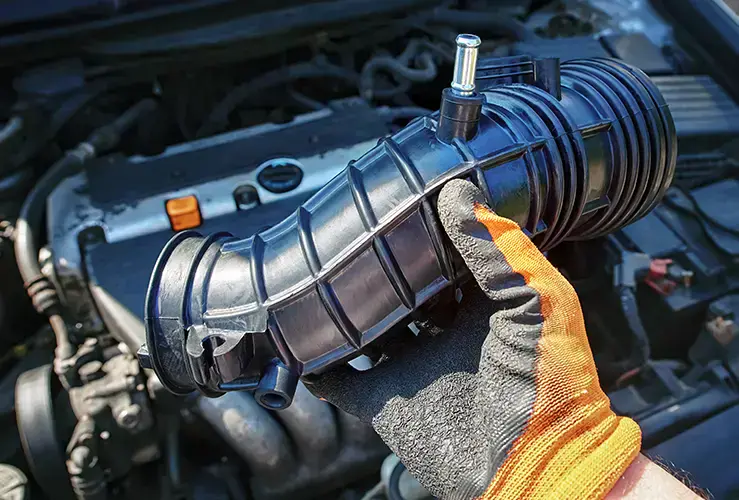
1. Vacuum leaks
In order to function properly, your vehicle’s engine harnesses a sealed vacuum system to regulate airflow, fuel mixture, and various other components like the brake booster. If a hose becomes cracked, disconnected, or forms a leak, extra air can enter the intake, causing engine over-revving.
Symptoms:
- Hearing a hissing or whistling noise from under the bonnet
- Noticing a rough or uneven idle
- Check engine light may come on
Solution: Have a look at your car’s vacuum hoses and intake connections. Swap out any damaged hoses and ensure that the clamps are secure. If you’re unsure how to do this, take your vehicle to your usual mechanic; they should be able to identify and remedy any problems swiftly.
2. Faulty Idle Air Control Valve (IACV)
The key function of your vehicle’s IACV is to manage idle speed by controlling how much air bypasses the throttle plate. If it’s stuck open, or malfunctioning, the engine may be getting too much air, resulting in those worryingly high RPMs.
Symptoms:
- Engine revs spike when idling
- Idle may surge up and down
- Your engine may stall if the IACV fails completely
Solution: Cleaning or swapping out the IACV usually fixes this kind of issue. On modern cars with electronic throttle control, the throttle body itself may need cleaning or calibrating. These latter tasks may be better handled by your trusted local mechanic.
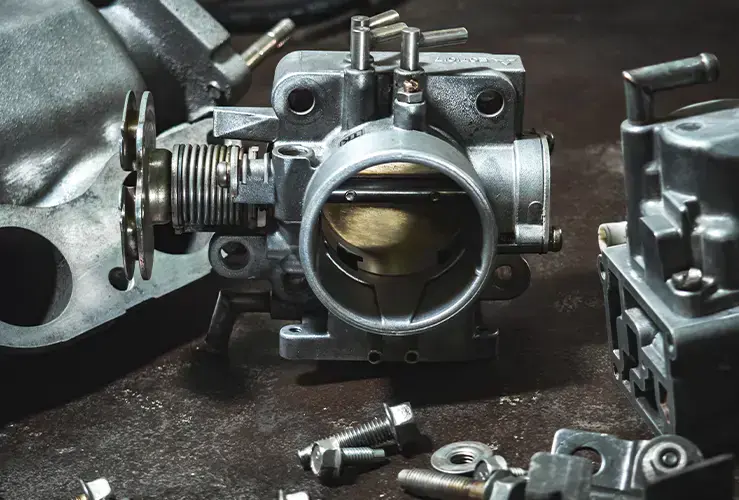
3. Throttle issues
If your vehicle’s throttle plate sticks, or the throttle cable is misadjusted, the engine may be getting more air than it actually needs or should be getting. In the same way, modern drive-by-wire systems can malfunction, causing the throttle to open slightly even when you’re not pressing the pedal. This results in (you guessed it!) higher revs.
Symptoms:
- Car revving high persistently - even after the car is warmed up
- You experience hesitation or jerking during acceleration
Solution: If you have the know-how, inspect the throttle body and cables. Cleaning the throttle plate or recalibrating the electronic throttle controls often fixes the issue. If unsure, take your vehicle to the garage for a once-over.
4. Faulty sensors
The engine of the average modern car relies on sensors like the Mass Air Flow (MAF) sensor, Manifold Absolute Pressure (MAP) sensor, or Engine Coolant Temperature (ECT) sensor to adjust fuel and air correctly. If a sensor fails or gives incorrect readings, you may experience the engine of your car revving high.
Symptoms:
- Check engine light
- Using more fuel than usual
- Rough or uneven running
Solution: A diagnostic scan should be able to identify faulty sensors. Cleaning or replacing the sensor usually fixes the problem. Your local mechanic should be able to help with this, unless you have the necessary equipment and know-how to do it yourself.
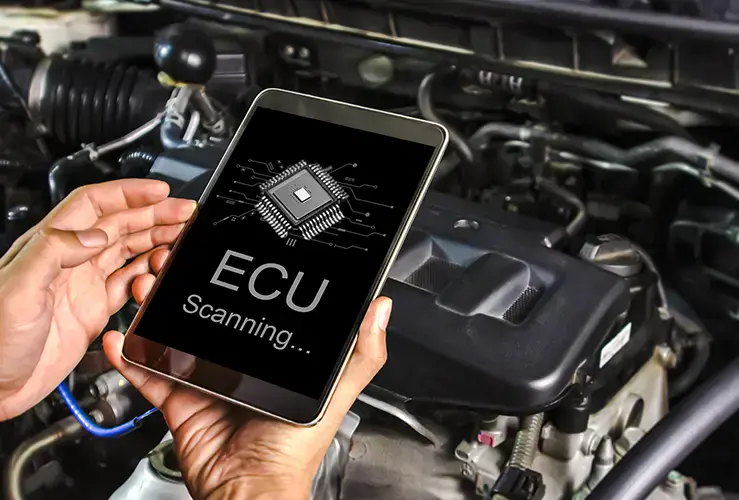
5. Engine control unit (ECU) issues
Modern engines are controlled by the ECU, which interprets data from sensors to adjust fuel and air delivery, and idle speed. A software glitch or electrical fault in the ECU can cause abnormal idle.
Symptoms:
- A high idle that doesn’t match up with engine temperature or load
- Check engine light appears on your dash
- Other erratic engine behaviour (sometimes an issue)
Solution: Some problems can be fixed with an ECU reset or software update at a garage. Persistent problems may mean you have to get a new ECU. The cost of a new ECU will depend on the make and model of your vehicle.
6. Sticking or worn-out components
Mechanical issues, like a sticking throttle shaft, a warped throttle plate, or a sticking EGR (Exhaust Gas Recirculation) valve, are another possible reason as to why your car is revving high.
Symptoms:
- Engine revs stay high even when all electronics are disabled
- Rough idle or engine vibration
Solution: Component cleaning or replacement may be necessary. This is one of the less serious issues that can be remedied fairly easily by your local mechanic.

Why you shouldn’t ignore high idle
Even if your car seems to drive normally, high idle can:
- Increase fuel consumption (costing you extra money)
- Cause excessive wear on engine components (meaning repairs are needed sooner)
- Overheat or stress parts like the timing belt/chain, alternator, and belts
- Lead to more serious engine damage, if the root cause is left to get worse
Also, a prolonged high idle can trigger warning lights or even affect emissions, which may lead to your car failing its MOT.
What to do if your engine is revving high
- Check for obvious issues: Loose hoses, visible vacuum leaks, or disconnected throttle cables.
- Scan for error codes: Modern cars’ onboard diagnostics (usually OBD-II) can identify sensor or ECU issues. Otherwise, your garage should have the required equipment.
- Clean or replace components: IACV, throttle body, or sensors are often the cause and can be fixed relatively easily.
- Seek professional help: If the problem persists, a qualified mechanic can perform a thorough inspection and prevent costly damage.
In conclusion
A car revving higher than normal is not something you should ignore. While some causes are simple and inexpensive to fix, others involve electronics or mechanical components that require professional attention. Early diagnosis and repair not only protect your car’s performance and longevity but also help maintain safety, fuel efficiency, and compliance with emissions standards.
By paying attention to unusual idle behavior and addressing it in good time, you can avoid bigger (and more costly) problems down the road, and enjoy a smoother, more reliable driving experience.