



Why does my car shake when idle? Discover the common causes, and solutions, with our helpful guide.
Has your car got the shakes? It’s not pleasant to sit at the traffic lights and feel your car trembling as though it’s struggling to stay alive. A gentle vibration is sometimes normal, but if your car is vibrating when idle to an unsettling degree, it might be a sign that something isn’t quite right. Understanding the potential causes can help you pinpoint the issue early on, thereby preventing further damage, and keep your driving experience smooth, enjoyable and safe.
Common causes of shaking at idle
If your car vibrates when idle, it could be down to one of the following issues:
1. Worn or damaged engine mounts
Engine mounts secure the engine to the vehicle’s frame and absorb vibrations. Without them, you and your passengers would have a very shaky, unpleasant ride. Indeed, when they wear out or crack, the engine’s natural movement gets transferred into the cabin. The result is a car that vibrates in idle, feeling like it’s trembling. The shaking may ease slightly once you accelerate, since forward momentum helps reduce the stress on the mounts.
Solution: Replacing faulty engine mounts is the only fix here. While it’s not usually an emergency repair, delaying it can cause extra strain on other engine components, which might result in other additional repairs and increased costs.
Replacing engine mounts is not normally considered a ‘big job’, but how much it costs will depend a lot on your car’s make, model, engine layout, and how easy it is to access the mounts (harder to access = more labour).
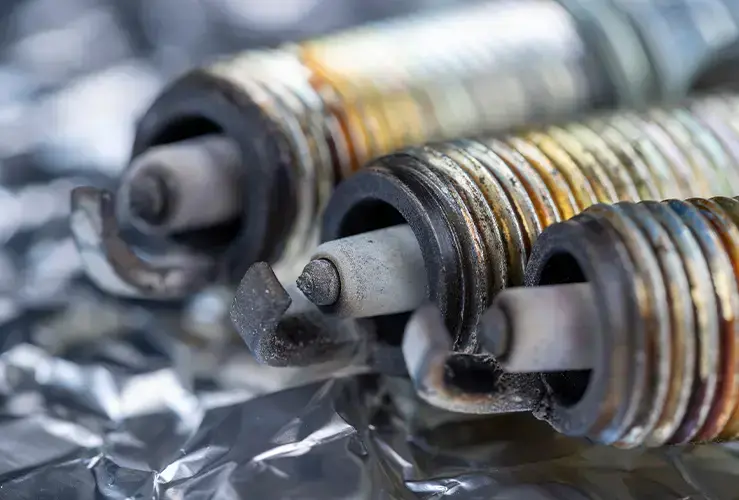
2. Dirty or faulty spark plugs
Spark plugs ignite the air-fuel mixture inside the engine. If they get dirty, worn out, or start misfiring, combustion becomes uneven. This can result in rough running and the engine shaking at idle. Along with vibrations, you might notice reduced fuel economy, sluggish acceleration, or a check engine light.
Solution: If you have the necessary mechanical know-how, you can inspect and replace spark plugs (and wires, if needed) yourself, as part of routine maintenance. Most modern spark plugs last between 30,000 and 100,000 miles, depending on the type. If, like many motorists, you’re unsure how to do this, take your car to your trusted local mechanic instead.
3. Clogged air or fuel filters
In order to run smoothly, engines need a precisely balanced mixture of air and fuel. If the air filter is clogged with dust or the fuel filter is blocked, you may well find that your engine shakes at idle. Inconsistent airflow or restricted fuel supply often shows up as vibration, hesitation, or even stalling.
Solution: Replace air and fuel filters at recommended intervals (check your vehicle’s handbook). They’re inexpensive components, and they can make a big difference to your car’s performance. If you have an air filter that’s already blocked, you can swap it out for a new one fairly easily. However, replacing a blocked fuel filter may be more tricky, and enlisting your local mechanic may be the best option.
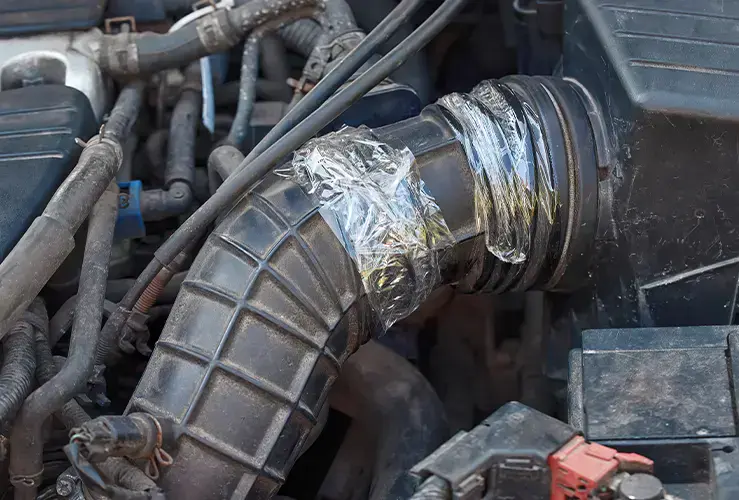
4. Vacuum leaks
Your engine relies on a sealed vacuum system to regulate airflow. If a hose becomes cracked, disconnected, or loose, excess air sneaks in and throws off the crucial air-fuel ratio. A vacuum leak may mean that your car vibrates when idle. You may also hear a high-pitched hissing sound from under the bonnet.
Solution: Finding vacuum leaks can be tricky. You’ll probably need outside help unless you have extensive knowledge of cars. Your local mechanic might use smoke testing to pinpoint the exact source before replacing hoses or gaskets.
5. Faulty idle speed control
Most modern vehicles have an idle air control (IAC) valve or an electronically controlled throttle body that manages idle speed. If the valve sticks or malfunctions, you may find your car is vibrating when idle. In some cases it may also surge or even stall.
Solution: Cleaning or replacing the idle control system usually fixes the issue. This might be a little trickier in older models. Visit your local garage for assistance.

6. Transmission issues
For automatic cars, transmission problems can sometimes cause shaking when the car is in gear but not moving. If the vibrations disappear when you shift into neutral or park, the transmission may be the culprit.
Solution: Transmission repairs vary widely in terms of cost and complexity. It’s best to have a professional mechanic diagnose the problem early, in preference to leaving it and having to deal with a bigger, costlier repair later.
Car vibrating when idle: When to worry
If your car vibrates when idle, it might not be a major problem. However, persistent or worsening vibrations should never be ignored. In some cases, what starts as a relatively minor issue (such as dirty spark plugs) can snowball into bigger and more expensive repairs if left untreated. It is best practise to act quickly just to be on the safe side.
Visit your mechanic if:
- The shaking is severe or sudden.
- You notice other symptoms, like stalling, misfires, or poor fuel economy.
- You see warning lights on your dashboard.
Will it lead to an MOT fail?
A car shaking when idling on its own won’t usually cause an MOT failure, but it could if the underlying problem affects things that are tested. So, it’s best to address any issues promptly, and certainly ahead of your next MOT.
In conclusion
If your engine shakes at idle, it isn’t just irritating, it’s a sign that something needs attention. From worn engine mounts to vacuum leaks, the causes vary, but most are fixable if caught early on. You should be able to avoid most issues by staying on top of regular maintenance tasks, like replacing filters and spark plugs.
If your car has begun to shake at idle, don’t ignore it. Have it checked out to keep your vehicle safe, reliable, and comfortable to drive.