


When used effectively, your cruise control can make driving less tiring and stressful and can even save you money on fuel. Learn how to get the best from your car's cruise control - and what can cause your cruise control to stop working.
What is cruise control?
Cruise control is a feature installed on most modern cars that enables you to travel at a steady speed without having to keep your foot on the accelerator pedal.
How does cruise control work?
- First, you accelerate to the speed you want
- You then press the cruise control button, and the speed is then ‘set’
- Your vehicle then maintains that speed, without any other input from you
- You’re able to go faster or slower by pressing up or down on the cruise control (usually in 1 mph increments)
- Pressing the brake (or clutch on manual cars) usually disengages the cruise control
What is cruise control used for?
A car’s cruise control is used for:
- Long motorway journeys, where it's appropriate to maintain a steady speed
- Preventing the fatigue that comes from having to keep your foot on the accelerator
- Helping to improve fuel efficiency by keeping to a constant speed
- Helping to prevent unintentionally going over the speed limit
What are the different cruise control variants?
There are two types of car cruise control:
Standard cruise control - which keeps your vehicle at a constant speed
Adaptive cruise control - which automatically keeps you at a safe distance front the vehicle in front
Where are cruise control buttons located?
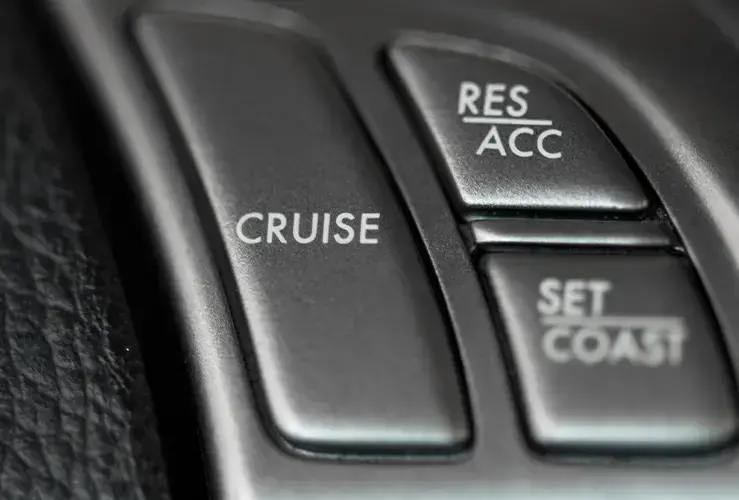
Most cruise control systems are controlled with buttons or toggles on the steering wheel, or on stalks on the steering column. There’s a button that lets you turn the entire system on or off.
As part of the controls, you’ll also have a ‘set’ button and a ‘resume’ button. These are sometimes combined with the plus (+) and minus (-) buttons. There will also be a ‘cancel’ button, which lets you disengage the cruise control without turning the whole system off.
These basic controls are universal across all cars.
Cruise control – real world example
Say you’re on a motorway and you reach a comfortable speed of 65 mph. You turn on your car’s cruise control. You can then press either the plus or minus button to set the cruise control at a particular speed. You would be able to take your foot off the accelerator, and the car will maintain the set speed.
You will continue to travel at the speed you have set, until you either:
- Press the ‘cancel’ button
- Press the brake
- Press the clutch (in manual cars)
Doing any of these will cancel the cruise control.
How to increase speed curing cruise control?
You can increase speed during cruise control by pressing the plus button (in 1mph increments).
You can also override the cruise control, without turning the system off, by putting your foot on the accelerator. This means you can speed up to overtake a vehicle (e.g. going from 65 to 70 mph), and then as you take your foot off the accelerator, the vehicle will slow down to match the speed set on the cruise control (eg from 70 to 65 mph again).
If you need to slow down, for example because you're approaching a roundabout, you simply apply the brakes. If this brings you down below the speed set on the cruise control (e.g. 65 mph), the cruise control will be deactivated. If you want to increase speed again, you can simply press the ‘resume’ button, which returns you to the previous set speed (e.g. 65mph).
If a vehicle ahead is moving at a slower speed than you, you can simply press ‘cancel’ and the cruise control will be disengaged.
Maintaining constant speed
As mentioned, one of the great benefits of cruise control is that you can maintain a certain speed without doing any of the work - i.e. you don’t need to accelerate and brake constantly. When using cruise control on a regular basis, you may notice that the speeds of other cars often increase on down slope, and decrease on an upslope, whereas your own speed stays constant.
When you get used to using cruise control, you may begin to rely on it more often. For example, if you’re travelling through a 40 mph zone, you can simply get up to 40 mph, then set the cruise control. You then don’t have to worry about exceeding the speed limit (or going too slow).
Cruise control with speed limiters
Many modern cruise control systems can be used in conjunction with speed limiters (which many modern cars have). While these systems often work in unison, they are actually separate.
Your speed limiter can be set to ensure you do not exceed a certain speed (e.g 30 mph). It can be useful for ensuring you do not break local speed limits, particularly when driving on unfamiliar roads. Most systems allow the limiter to be overridden in emergencies, usually by pressing hard on the accelerator pedal.
In short, a limiter is best for town driving, while cruise control is most useful on motorways.

Are there any safety issues with cruise control?
Reduced driver attention
When using cruise control, it’s possible that you might become less focused on the road because you’re not actively controlling the speed. It’s important that you always keep your hands on the wheel and eyes on the road.
However, some drivers say that using cruise control gives them more ‘bandwidth’ to keep an eye out for potential hazards, since much of the speed control is being done by cruise control.
Not suitable when driving in bad conditions
Rain, snow, ice, or heavy traffic: Cruise control can be dangerous to use because it may cause the car to slide or react too slowly. On slippery surfaces, sudden braking or loss of traction can happen.
Delayed reaction to hazards
It’s also possible that you may react slower to unexpected obstacles/hazards since the car is controlling speed. Adaptive cruise control helps mitigate this issue by adjusting speed automatically, but, importantly, standard cruise control does not.
Over-reliance
Some drivers may assume that using cruise control will prevent accidents, but it’s important to note that it cannot steer, brake quickly, or avoid collisions.
Manual transmission caution
Using cruise control in manual cars requires careful operation of the clutch; incorrect use can cause engine issues or loss of speed control.
Hill driving
On steep hills, standard cruise control may struggle to maintain the required speed. On a downhill slope, it won’t slow the car automatically so you may need to brake manually.
What to do if your cruise control has stopped working?
If your cruise control has stopped working, it usually isn’t cause for alarm. However, you should get it fixed promptly. Here are some things to check if you think you have a faulty cruise control.
First, check basic settings: it sounds obvious, but make sure the cruise control is switched on. Ensure the car is at a sufficient speed (usually above 25–30 mph) for the cruise control to work. Ensure that the brake or clutch isn’t being pressed, as this would disable the cruise control.
Check your cruise control fuse: many systems have their own fuse. If this has blown, replace it. Check your manual for fuse box location. This is a common cause of a faulty cruise control system.
If your check engine light or ABS/traction control light is on, the cruise control system may have been disabled as a safety precaution. A diagnostics scan may be needed to determine what the fault is.
Your cruise control relies on various components, including speed sensors, throttle cables, and electronic modules. If any of these are faulty, the system won't work properly.
Some cruise control systems need to be reset if there have been extensive repairs or battery replacement; check your manual.
Most drivers will opt to get their cruise control system looked over by a professional: they should be able to pinpoint and solve the issue swiftly.