

What is a total loss in terms of car insurance? If your car is damaged, your insurer will place it in one of four categories - two of which mean your car will never be driven again. Learn about these different categories, and what’s involved with a total loss of a vehicle.
"It's a write off."
Hearing or reading these words from your insurer is generally not a pleasant experience, and may mean your vehicle will never be driven on public roads again.
What is a write off?
If your vehicle is involved in a collision, stolen (and then recovered), or otherwise damaged, your insurer will need to decide whether or not to class it as a "write off”.
They need to decide if it is too expensive to get your vehicle in a condition where it is roadworthy once more (if not, the car is a total loss).
As a rough rule of thumb, if the cost of repair exceeds 50-70% of the car's value, your insurance provider will consider it a total "write off", and pay you its market value before the damage occurred, minus any excesses.
How common are write offs?
If you've been told your car is a write off, you're in good (if sombre) company.
According to financial services provider Allegiant, 562,185 vehicles were written off in 2024. This figure has risen steadily since 2020, although in 2019 (pre-Covid) write-offs were similarly high.
Based on recent figures, around 1.34% of UK vehicles are written off annually, so there's a small but not insubstantial chance of you having to deal with a write-off.
Write off categories: A, B, S, N
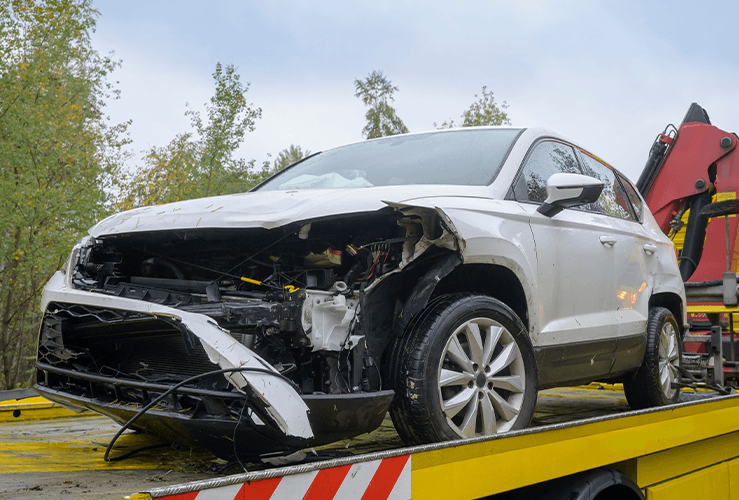
If your vehicle has been damaged, your insurer will place it in one of four categories: A, B, S or N. These categories have been established by the Association of British Insurers, and help all stakeholders (insurers, repairers, buyers) to understand how badly a vehicle has been damaged.
In very basic terms, if your vehicle has been classed as A or B it's curtains for the vehicle in question. It will either be completely scrapped or sold for parts. As and Bs are “total loss vehicles”.
If it lands in 'S' or 'N', it can usually be repaired and eventually driven again - although they are still technically “write offs”.
Here's a more detailed run-down of what each category means:
Category A – scrap only
These vehicles are beyond repair and must be crushed in their entirety, including all parts. Category A cars are usually those that have suffered catastrophic damage for example, in severe accidents or fires. It would be illegal for any part to be reused. It is unequivocally a total loss vehicle.
Category B – break for parts
A Category B write-off means the car is too damaged to return to the road, but some components can be safely salvaged. The body shell must be destroyed, but parts like wheels, seats, or engines might be sold or recycled. Bs are also “total loss vehicles”.
Category S – structurally damaged but repairable
Previously known as Category C, this classification means the car has sustained structural damage (for example, to the chassis or crumple zones) but can be repaired safely. Once repaired, it must pass an inspection before being driven again or sold.
Category N – non-structural damage
Formerly Category D, this means the vehicle has suffered non-structural damage - such as to electronics, suspension, or body panels but remains fundamentally sound. Category N cars can often be repaired and returned to the road more easily and cheaply than Category S vehicles.
What if my vehicle has been stolen?
If your vehicle has been stolen, it won't be given a classification unless it is recovered (and of course it may not be damaged at all). Most insurers wait between 14 and 30 days after the theft is reported before they settle the claim.
How does my insurer decide if my vehicle is a write off?
Your insurer will use several factors to determine whether a car should be written off:
Repair costs: This is a major factor. Labour, parts, and VAT can quickly add up. If these costs exceed a certain percentage (typically 50–70%) of the vehicle’s market value, it’s often declared as a total loss.
Vehicle age and value: Older or less valuable cars are more likely to be written off, even with relatively minor damage.
Safety concerns: Even if repairable, a vehicle might be deemed unsafe or uneconomical to return to roadworthy condition.
Salvage value: Insurers also look at how much the damaged car is worth as scrap or salvage.

Car insurance total loss claim: What happens?
If your insurer classifies your vehicle as a "total" loss, they will offer you some money for it - this is known as a "settlement payment". It's based on what they say the vehicle was worth before the damage occurred.
They'll look at what vehicles of a similar age, model and condition are worth in the current market.
What if you believe the value is too low?
Total loss car insurance settlements in the UK are somewhat negotiable. If you think the insurer's offered settlement payment is too low, you can ask them to review it but make sure you offer evidence to back up your assertion (such as current listings for similar used vehicles). It's not out of the question that they'll agree with you. When it comes to something as financially impactful as total loss insurance, car insurers have to be seen to be fair.
After settlement, ownership of the written-off vehicle usually transfers to the insurer. However, if it’s a Category S or N write off, you may have the option to buy it back (known as retaining the salvage). You could then repair it privately and have it inspected before putting it back on the road.
Cars on finance or lease: What happens?
If your car is on finance or lease, the payout usually goes directly to the finance company. You may still owe money if the settlement doesn’t cover the full balance. This is where Guaranteed Asset Protection (GAP) insurance can be invaluable: it covers the difference between your insurer’s payout and what you owe.
Insuring a previously written-off car can also be a bit more complicated than usual. Some insurers simply won't cover Category S or N vehicles, while others will hike up the premium. Always tell any prospective insurer about the car’s write off history. If you don't, it could invalidate future claims.

4 tips for being write off ready
Check the market value: Keep an eye on your car’s rough value using sites like Auto Trader or We Buy Any Car as this will help you work out if an insurer’s offer is fair.
Keep records: Service history, receipts, and photos showing your car’s condition can all boost your case for a better payout.
Consider GAP insurance: Particularly useful for newer cars bought on finance or lease. There's a small chance you'll need it, but it could be a huge help if you do.
Run an HPI Check: If buying a used car, always run a check to see if it’s been previously written off and ensure it’s been properly repaired.
Are write offs more common these days?
Yes - modern vehicles are increasingly complex. Fixing them can mean they cost a lot in terms of parts and labour. Other factors include quicker depreciation, higher safety standards, and any issues with parts delays/supply chain - all of which can push an insurer to a category A or B “write off” decision.
Is a write off ever a good thing?
Being told you have a total loss vehicle doesn't sound great, but there are situations where it can be advantageous.
For example, it could save you the time, stress and uncertainty of getting repairs done.
Additionally if it' s classed as repairable S or N, you may be able to buy it from the insurer for its salvage value, then repair it yourself. In this case you would receive the payout for the pre-damage market value, then pay the salvage value. If you can get the repairs done inexpensively, you could potentially come out ahead financially.
You might also avoid the long-term reliability risks that sometimes follow major accident repairs i.e. there could be mechanical or electrical issues brewing that you weren't aware of.
Additionally, if you have Guaranteed Asset Protection (GAP) insurance, any final balance on your car will be paid - which could leave you better off financially.
Finally, it simply gives you the chance to upgrade and perhaps choose a new or more reliable vehicle.
Conclusion
In order to minimise the impact of dealing with a write off (and perhaps even turning it to your advantage!) it's important to understand the different write off categories, and how to negotiate a fair settlement for your old vehicle.
Insurance write offs are a part of today's motoring landscape, and the more prepared you are to deal with one, the better off you'll be if it happens.