



When can you use the hard shoulder on a motorway? Learn when you can, and cannot, use this important component of the UK motorway network (including on Smart Motorways), and about the penalties for improper use.
The ‘hard shoulder’ is a critical piece of motorway infrastructure. It’s a lane located on the left of the motorway, marked by a solid white line. As far as possible, it should be kept entirely clear, and should only be used by drivers if they’ve suffered a problem with their vehicle, a medical issue, and in some limited circumstances if the authorities permit it (e.g. in relation to traffic management), and of course, emergency and breakdown service vehicles can use the hard shoulder as required.
In this article we’ll explore how the hard shoulder should be used, and what penalties apply if you break the rules.
What is the hard shoulder on a motorway?
What is the hard shoulder in driving terms? In short, the hard shoulder is around 3.3 metres wide, providing enough space for the vast majority of vehicle types. The surface of the hard shoulder is often a different colour and texture to the adjacent motorway lanes, making it easy to identify.

When can I use the hard shoulder?
The hard shoulder must only be used in very specific situations:
Breakdowns and medical issues: If your vehicle has developed a mechanical issue or you feel unwell, signal left and move into the hard shoulder lane - as far to the left as you can. Then come to a stop, turning your steering wheel fully to the left, apply handbrake, and turn your hazard lights on.
Directed by police, highways officers, or road signs: Generally, using a hard shoulder in a traffic jam is not allowed (and is illegal). However, in some cases, on some motorways, electronic signs above the motorway (called red X signals) will show when the hard shoulder is open as a temporary lane for example, if there’s heavy traffic or roadworks.
To let emergency vehicles pass: If there’s an emergency vehicle behind you, and there’s no space to move out of the way, you may briefly use the hard shoulder in order to let the emergency vehicle go past.
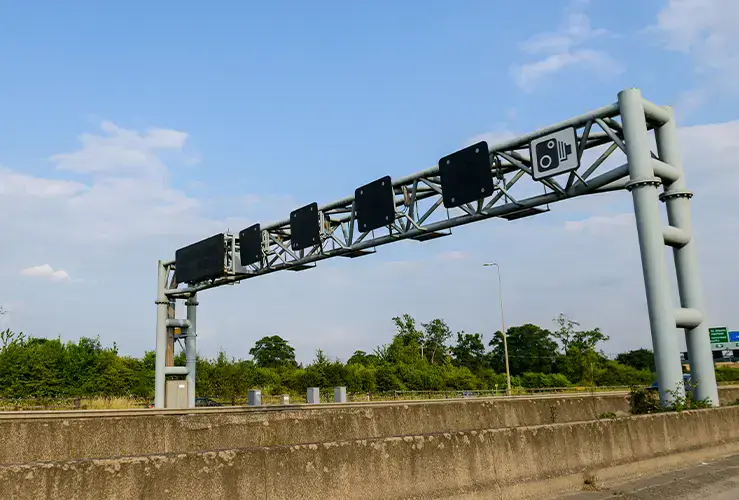
What about hard shoulders on Smart Motorways?
The situation gets a bit more complicated when it comes to ‘Smart Motorways’. These motorways may temporarily allow traffic to use a hard shoulder (aka ‘hard shoulder running’) usually in order to ease traffic congestion. A sign above the hard shoulder will inform drivers that they can use the lane by displaying the temporary speed limit.
However, if you see a red ‘X’ on the gantry sign above the hard shoulder, it is closed and must not be used.
Unless you have a valid reason for it, stopping on a hard shoulder is an offence. Using a closed hard shoulder lane on the motorway can result in a £100 fine and three penalty points on your licence.
If you break down on the hard shoulder: Staying safe
If you have to stop, follow these steps to stay safe:
- Pull up as far to the left as possible
- Turn on your hazard lights and, in low light/darkness, your sidelights too
- Exit the vehicle by the passenger side (away from the traffic)
- Stand behind the barrier, a good distance from the motorway
- Use the emergency phone on the verge if you don’t have a mobile signal as these connect directly to National Highways control rooms
Never try to fix your car while it’s on the hard shoulder unless absolutely necessary. Wait for help from your breakdown provider or authorities.

How to rejoin the motorway from the hard shoulder?
Make sure it’s safe to move off
Make sure the engine is working and tyres are all inflated. Put seatbelts on, then wait for a clear gap in the traffic.
Build up speed on the hard shoulder
Assuming the hard shoulder is clear ahead of you, build up speed to match the adjacent traffic.
Check mirrors and blind spots
Use your mirrors and be ready to indicate that you will move into the left lane on the motorway. Glance over your right shoulder to check for nearby vehicles. Ensure any gap is large enough to move into safely.
Merge into the left-hand lane
Indicate right and move carefully into the left-hand lane. Cancel your indicator and match your speed with the traffic flow.
What about on Smart Motorways?
Do not start moving on the hard shoulder if it is closed (as indicated by a red ‘X’ on the overhead sign). However, in some cases you may be instructed to move off by the police or highway authorities.
Extra tips
- Always use your hazard lights before moving off if visibility is poor or traffic is heavy.
- If you’re nervous about merging, wait until traffic eases sufficiently as the safety of yourself and any passengers is paramount.
- Never reverse along the hard shoulder to reach a junction or lay-by.
Why is it called a hard shoulder?
The term ‘shoulder’ is used because, as with humans, it is on the side/edge (of the body/road).
The term ‘hard’ is used because it is hard enough to bear the load of heavy vehicles. Decades ago, a grass verge would have been more common on roads - but the ‘hard’ underlines the fact that this shoulder is indeed hard.
Hard shoulder: Key takeaways
The motorway hard shoulder should only be used in very limited circumstances: if you break down, feel unwell, or if authorities/overhead gantries permit it or require it.
It’s critical that the hard shoulder stays open to allow free movement of emergency and breakdown service vehicles, so they can help people who really need it. Remember that unless you have a proper reason for it, stopping on a hard shoulder is an offence and could cost you £100 and three penalty points on your licence.