


Learn why wearing slippers, sandals and flip flops while driving could be dangerous and how the law might come into play - especially if wearing unsuitable footwear contributes to an accident.
According to a 2024 survey by UK insurer Aviva, 16% of drivers admitted to wearing flip flops or sliders while driving, while 10% said they had driven barefoot.
Driving in certain types of footwear, or without any footwear, can make it more difficult to control your vehicle but is it illegal?
In short, there are no specific UK laws that prohibit motoring in certain footwear types, or barefoot.
However, Rule 97 of the UK’s Highway Code states that: “You should ensure that clothing and footwear do not prevent you using the controls in the correct manner.”
So whilst “why is it illegal to drive barefoot” is sometimes searched for online, it is an erroneous assumption; driving barefoot is not illegal, but if doing so (or wearing inappropriate footwear behind the wheel) does result in a collision, you could find yourself in serious trouble.
This is because you could be deemed as "driving without due care and attention".
Police can issue an on-the-spot fine of £100. If a case goes to court, you could be handed much larger fines, get points on your licence, or even be given a driving ban. In cases of severe accidents involving serious injury or death where inappropriate footwear was a factor, charges like "dangerous driving" and imprisonment are possible.
Wearing slippers or sandals while driving - why it’s a bad idea
Wearing slippers or sandals while driving may offer more comfort in some ways, but because they are thin and loose, they make it more difficult to use the pedals of your vehicle. For example, you may not be able to apply the brakes as quickly and forcefully as you would if you were wearing more suitable shoes.
It’s a similar story with driving in high heels, your foot could slip off and you may not have full control.
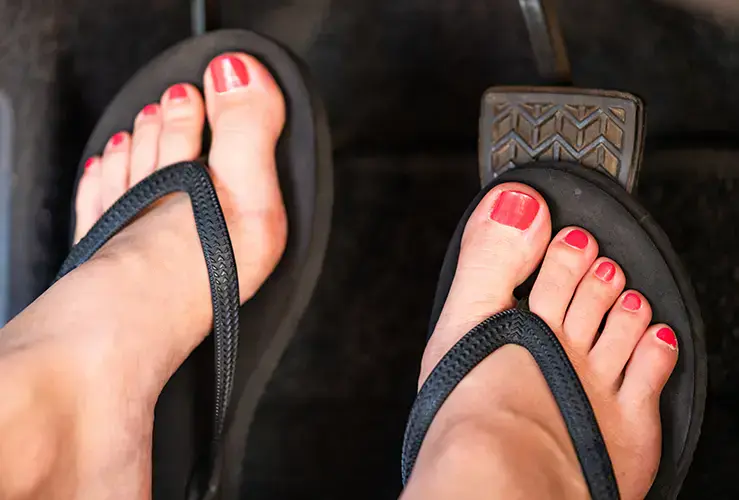
Why it’s dangerous to wear thin soled shoes for driving
Thin soled shoes like flip-flops are unsuitable for driving because they can easily slip off, lack enough grip, and they can even get tangled in the footwell. They also don’t give you much ankle support. All told, this can interfere with your ability to properly apply pressure to the pedals and could cause a serious accident.
But thick soled shoes can be risky, too
Heavy and thick-soled shoes are a bad idea for driving because they dangerously limit your control and feel of the pedals. While it is not exactly illegal to wear them in the UK, wearing any sort of footwear that reduces your ability to drive safely could lead to fines, penalty points, or worse, an accident.
Worst shoes for driving
While there is no exact legal definition of ‘worst shoes for driving’, it’s best to avoid slippers, flip flops, sandals, high heels, thick-soled shoes and heavy boots.
What is a driver shoe?
While there is no technical or legal answer to “what are driving shoes?” they are generally considered to be lightweight shoes designed specifically to give the driver better control, comfort, and “pedal feel" while driving. The sole should not be too thick or too thin, there should be sufficient ankle support, and you would be able to feel the pedal. They will also not be too wide to prevent accidentally making contact with the wrong pedal.
Choosing safe footwear for driving
With the above in mind, choose driving shoes that have soles of about 10mm thickness, offer ankle support, grip, and good ‘pedal feel’. For optimum safety and control, it is best to wear shoes that:
- Fit securely to your foot
- Are lightweight and comfortable
- Have non-slip soles
- Allow free movement of your ankles
- Are narrow enough to prevent you from accidentally pressing two pedals at once